A new public space project offers an ambitious vision—so why is the city implementing it at such a small scale?


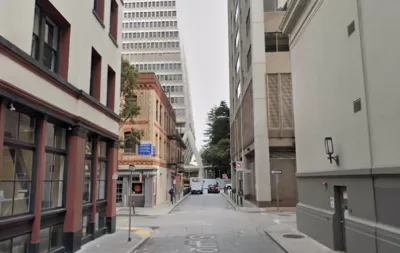
A redevelopment project in San Francisco is being touted by local boosters as “a bellwether for the resurgence of a struggling downtown,” writes Patrick Sisson in Fast Company. An alleyway now called the Landing at Leidesdorff, designed by SITELAB, “will feature removable street seating, murals recalling the area’s maritime history as a former wharf, and a village-like atmosphere in the center of downtown, complete with events and programming.”
The project is one effort to revitalize languishing public spaces around office buildings with vacancy rates of up to 31 percent. For Sisson and others, like SITELAB’s Laura Crescimano, the small scale of the project falls short of its grand vision. “Despite a year of work to make it happen, despite the wealth of historic architecture, support from the Mayor’s office and $385,000 in city investment, San Francisco will only pedestrianized a single alleyway as a pilot project (it will be car-free for 16 hours a day).”
But changing the shape of public space in downtowns can be tough. “Cities have traditionally over-indexed on offices because it was a way to make money on property taxes without having to provide the public services, like schooling, that residential neighborhoods demand.” Now, it will take effort to “restore a more diverse ecosystem.”
FULL STORY: The solution to cities’ downtown doom loop is simpler than you think

Analysis of Downtown Recoveries Reveals Post-Pandemic Winners and Losers
The recovery of U.S. downtowns is happening at widely different paces depending on which city you consider.
Downtown San Francisco Still Looking for a Post-Pandemic Comeback
“Downtown on the Brink” reads the headline of a recent San Francisco Chronicle feature.
With Zero Office Conversions in Four Years, San Francisco Pins Hopes on New Special Financing District
City leaders hope the new incentive will spur the redevelopment of some of the city’s 30,000 square feet of vacant office space into housing.

The state-sanctioned urbicide of Austin
People don’t kill cities. Freeways do.

US to reduce Colorado River water deliveries to Mexico
A new Colorado Treaty amendment reduces Mexico’s Colorado River water allocation by 250,000 acre feet.

New Jersey’s second-largest city bans standalone data centers
Jersey City will continue to allow co-location facilities, such as those meant for research institutions that store their own data.

Amtrak not solely to blame for New Jersey commuter rail's unreliability, report finds
A new study from the Garden State Initiative found that NJ Transit’s budget grew 20% across a 4 year period, but reliability declined significantly over the same period.

EPA erases limits on planet-warming pollution from power plants
Under Monday’s plan, power plants would still have some limits on how much mercury, arsenic and other contaminants they can emit.

Phoenix announces new on-demand transit service, more frequent RAPID buses
Both new services will launch in October, and are part of Phoenix's Project Effective Access Solutions for Easing Congestion.

FREE Course: Walkable City 1: Why Walkability?
After describing his path towards focusing on walkability as the essence of good planning, Jeff Speck marches through his five principal reasons for making more walkable places.
Reinventing Malls: Planning Alchemy—Turning Gray Fields Into Gold
The course focuses on the opportunities and imperatives that shape reinvention of mall sites.

Eagle County Government
Harvard University Graduate School of Design
Nashville Planning Department
The Architects Foundation
University of Cincinnati Online
The Pocatello Development Authority
The Urban Renewal Agency of the City of Pocatello
Journal of the American Planning Association