Food trucks, outdoor dining spaces, and parklets are moving the needle toward more people-friendly cities and less car-oriented streets.


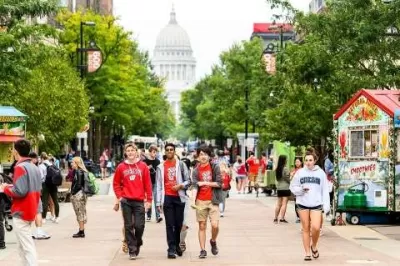
Using Madison, Wisconsin’s Library Mall as an example, Kyle Hoff points out the connection between food trucks and pedestrian- and cyclist-friendly spaces in an article in the Congress for New Urbanism’s Public Square. “For most Americans, food trucks or pop-up tents at an occasional event like farmers markets are the closest thing they will experience to a permanent outdoor market/public plaza like those that can be found more frequently in European cities and elsewhere in the world.”
Food trucks, Hoff points out, thrive in pedestrian-friendly areas with rich foot traffic. As the natural experiment prompted by the Covid-19 pandemic showed, outdoor dining and parklets can boost activity at local restaurants and businesses.
For Hoff, “This is just one example of how pedestrian-friendly design is great for entrepreneurs, pedestrians, and cities as a whole.” As a civil engineer, Hoff urges their peers to design roads and public spaces to encourage activity like food trucks by “narrowing drive lanes, removing on-street parking in cases where the space can be used more efficiently and profitably, and implementing other design measures to make driving fast in cities uncomfortable, and make being outside of a car more comfortable.”
Read the full story: Food trucks and people friendly cities

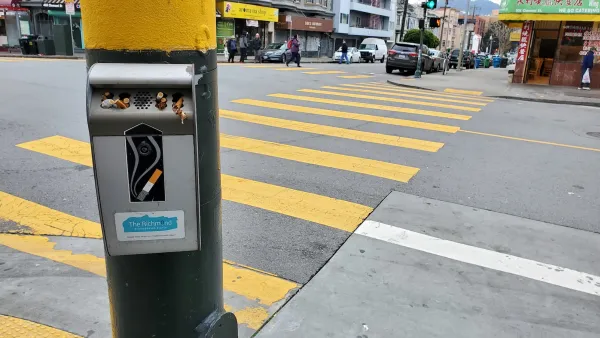
San Francisco weighs patio smoking ban
Business owners say the ban could force patrons onto sidewalks and disrupt long-standing bar culture, while proponents of the ordinance say second-hand smoke is a threat to patrons and workers.
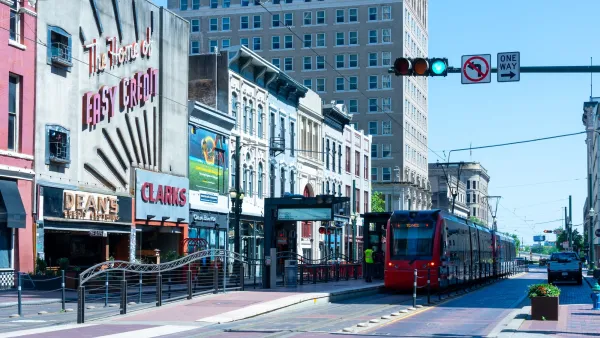
Houston's pedestrian promenade on track to be ready for World Cup crowds
The city is transforming seven downtown blocks along a light rail line into a car-free zone focused on outdoor dining and entertainment.
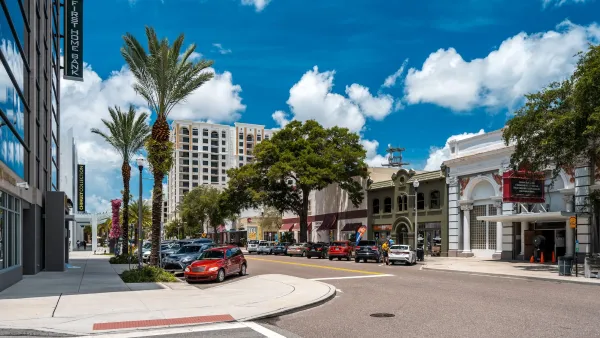
Downtown St. Petersburg Poised for Pedestrian-Friendly Makeover
A new vision for Central Avenue includes wider sidewalks and more space for outdoor dining.

Planetizen Federal Action Tracker
A weekly monitor of how Trump’s orders and actions are impacting planners and planning in America.

The state-sanctioned urbicide of Austin
People don’t kill cities. Freeways do.

US to reduce Colorado River water deliveries to Mexico
A new Colorado Treaty amendment reduces Mexico’s Colorado River water allocation by 250,000 acre feet.

Nation's most wind-powered state turns to coal as data centers increase energy demand
For the first time in decades, Iowa has increased its generation of coal power.

NYC cools commuters with city's first rain garden above a bus stop
New York City officials say the plants in the rain garden can absorb 16 gallons of rainwater during heavy storms.

Brightline West’s future may rely on $6 billion federal loan
The company has until Nov. 2 to make a $400 million equity investment into its proposed high-speed rail line.

FREE Course: Walkable City 1: Why Walkability?
After describing his path towards focusing on walkability as the essence of good planning, Jeff Speck marches through his five principal reasons for making more walkable places.
Reinventing Malls: Planning Alchemy—Turning Gray Fields Into Gold
The course focuses on the opportunities and imperatives that shape reinvention of mall sites.

Eagle County Government
Harvard University Graduate School of Design
Nashville Planning Department
The Architects Foundation
University of Cincinnati Online
The Pocatello Development Authority
The Urban Renewal Agency of the City of Pocatello
Journal of the American Planning Association