A new study shines a light on the connection between homeless outreach teams and policing, and examines why so many cities still use resident complaints to guide their response to the homelessness crisis.


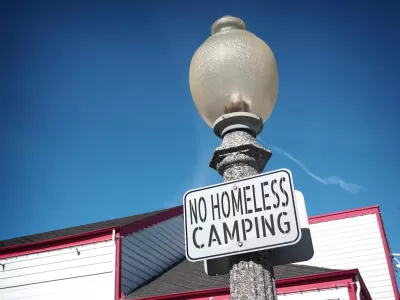
The way to resolve homelessness is to provide people with housing. But many cities continue to use punitive approaches, including deploying police to clear encampments. These policies can and often do coexist with ostensible “services,” sometimes introduced through city-run homeless outreach teams. Why do so many American cities seem vexed when it comes to homelessness, promising to take a compassionate approach while simultaneously framing unhoused people as a threat to public safety?
A big reason for this is that complaint-driven policies prevail in many cities despite being antithetical to resolving homelessness. Mayors and other political figures fear community blowback, and rather than focusing on the real problem—that people are experiencing homelessness—mayors instead adopt policies designed to placate people who are housed and who do not wish to see unsheltered street homelessness.
These complaint-driven policies, centered around deploying police or sanitation workers to places where public encampments are reported, are oriented around “solving” the problem of visible, unsheltered homelessness and persistent encampments. The forced clearing of encampments—often referred to as “sweeps”—can lead to lost or discarded identification, clothing, medications, or other critical belongings. It can disperse people far from their support network, including family who can check up on them or social workers familiar with their cases. It can also lead to arrests or confrontations with police that can exacerbate their houselessness long-term.
This type of policy is nominally connected to services, until unhoused people discover that the services—including permanent housing or social supports—don’t exist, were not what was promised, or come with curfews and other restrictions that cause them to return to the street in frustration. The end result is that homelessness persists, even grows, and that trust between people living on the street and the city governments purportedly offering them services erodes.
A new report from Boston University, Cornell, and a nonprofit, Community Solutions, reveals the extent of punitive and complaint-driven policies within mayors’ offices and city governments across the country. Building on a 2021 survey of mayors and a previous report on the impact of zoning on homelessness, which found that housing policies are often disconnected from homelessness policies, the report’s authors looked at homeless outreach teams across the country, tracking what their goals and missions are and how they operate.
The report reveals that 76 percent of homeless outreach teams in the nation’s 100 largest cities involve the police. And 59 percent of the outreach teams studied are designed to enforce ...
See the source article below to continue reading.
FULL STORY: Sweeps Aren’t Outreach—Policing Homelessness Still Doesn’t Work

Berkeley promised to build supportive housing in People's Park. Where is it?
More than two years after People's Park was cordoned off, there is no word on a timeline for a promised affordable housing project.
Cleveland program has housed 200 people since 2024
The A Home For Every Neighbor initiative successfully moves people into housing in under two weeks.
"A grim march toward death": What HUD’s new homeless policy looks like on the ground
Administrators from 55 Continuum of Care sites share their views on how proposed cuts, rapid changes to funding guidelines, and delays are affecting their work.

The state-sanctioned urbicide of Austin
People don’t kill cities. Freeways do.

US to reduce Colorado River water deliveries to Mexico
A new Colorado Treaty amendment reduces Mexico’s Colorado River water allocation by 250,000 acre feet.

New Jersey’s second-largest city bans standalone data centers
Jersey City will continue to allow co-location facilities, such as those meant for research institutions that store their own data.

Amtrak not solely to blame for New Jersey commuter rail's unreliability, report finds
A new study from the Garden State Initiative found that NJ Transit’s budget grew 20% across a 4 year period, but reliability declined significantly over the same period.

EPA erases limits on planet-warming pollution from power plants
Under Monday’s plan, power plants would still have some limits on how much mercury, arsenic and other contaminants they can emit.

Phoenix announces new on-demand transit service, more frequent RAPID buses
Both new services will launch in October, and are part of Phoenix's Project Effective Access Solutions for Easing Congestion.

FREE Course: Walkable City 1: Why Walkability?
After describing his path towards focusing on walkability as the essence of good planning, Jeff Speck marches through his five principal reasons for making more walkable places.
Reinventing Malls: Planning Alchemy—Turning Gray Fields Into Gold
The course focuses on the opportunities and imperatives that shape reinvention of mall sites.

Eagle County Government
Harvard University Graduate School of Design
Nashville Planning Department
The Architects Foundation
University of Cincinnati Online
The Pocatello Development Authority
The Urban Renewal Agency of the City of Pocatello
Journal of the American Planning Association