Pickleball may be America's fastest growing sport, but it is not universally loved because of the noise it causes. Learn one expert's ideas for mitigating the noise impacts.


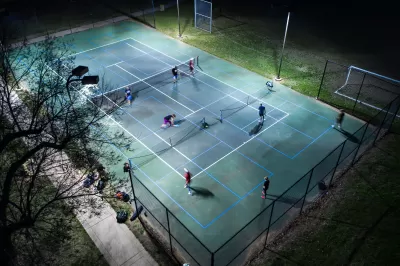
Pickleball, a racquet-based sport that combines elements of tennis, badminton and ping-pong, is one of the fastest-growing sports in the United States. It can be played indoors or outdoors, and the courts and nets are smaller than their tennis counterparts. Using a paddle and a plastic ball with holes, the sport can be played either as a singles or a doubles game. Pickleball first found popularity among active adults and retirees as a less physically demanding alternative to tennis, but today the sport is enjoyed by all ages and skill levels.
While playing pickleball offers health and other benefits, it also has impacts that need to be considered and mitigated. The major negative impact associated with pickleball is noise. When the hard surface of the pickleball racket connects with the hard surface of the ball, sound waves vibrate rapidly, registering a decibel level of around 70 dBA at 100 feet from the court. (In comparison, tennis noise is closer to 40 dBA.)
This article by Mark Dent features Bob Unetich, a retired engineer, university professor, and founder of Pickleball Sound Mitigation LLC. He has become a go-to source for information in the pickleball wars, studying everything from paddles to the placement of courts. When Unetich has discussions with clients, he gives a primary piece of advice: Do whatever you can to ensure that the average sound emanating from the court to the nearest homes is 50 dBA or less.
According to Unetich's studies and experience, residents of suburban areas generally do not complain about that noise level, which is a few decibels above typical suburban background noise. In noisier city environments, Unetich has proposed a maximum noise limit of 3 dBA above the background sound. Getting down to 50 dBA is possible with planning. Data from one of Unetich’s papers estimates that even in a wide-open space the sound of pickleball will likely be tolerable to people living at a distance of 977 feet or farther from a court, and anecdotally he has rarely heard complaints from people living more than roughly 500 feet away.
For more information, please read the source article.
FULL STORY: One man’s quest to make pickleball quiet


Study: Silence Raises Property Values
A Florida study found homes near recently built sound walls saw a rise in value.

‘Quiet Parks’ Highlight Importance of Silence for Public Health
The initiative recognizes parks and other areas that preserve natural quiet in a world full of noise pollution.

Estonian Capital Launches Noise Reduction Action Plan
European Union cities are required to create ‘noise maps’ and strategic plans for reducing environmental noise.

Planetizen Federal Action Tracker
A weekly monitor of how Trump’s orders and actions are impacting planners and planning in America.

The state-sanctioned urbicide of Austin
People don’t kill cities. Freeways do.

US to reduce Colorado River water deliveries to Mexico
A new Colorado Treaty amendment reduces Mexico’s Colorado River water allocation by 250,000 acre feet.

5 New England states march closer to 800 megawatt wind energy project
Securing federal approval for the project may be complicated under the Trump administration, which has historically been hostile towards domestic wind power.

Baltimore to break ground on $50 million Transit Priority Project
The project will bring faster bus trips, safer streets and better bike connections to Baltimore.

Airbnb launches $250 million 'last-dollar financing' housing accelerator, makes first investment in Austin
The company will put $6.4 million towards affordable housing development in Texas’ capital.

FREE Course: Walkable City 1: Why Walkability?
After describing his path towards focusing on walkability as the essence of good planning, Jeff Speck marches through his five principal reasons for making more walkable places.
Reinventing Malls: Planning Alchemy—Turning Gray Fields Into Gold
The course focuses on the opportunities and imperatives that shape reinvention of mall sites.

Eagle County Government
Harvard University Graduate School of Design
Nashville Planning Department
The Architects Foundation
University of Cincinnati Online
The Pocatello Development Authority
The Urban Renewal Agency of the City of Pocatello
Journal of the American Planning Association