Environmentalists are raising the alarm about massive solar farms in the unspoiled desert. Why not install more solar panels along state-owned highways and in parking lots instead?


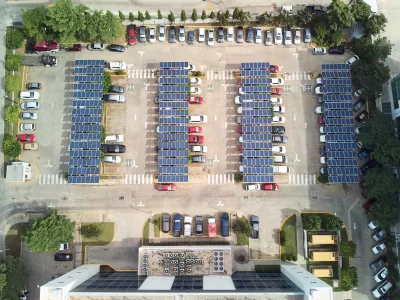
In an editorial published last week, the Los Angeles Times Editorial Board calls on California leaders to “think creatively and find ways to put more solar energy in already built-out places, including rooftops and parking lots, canals and agricultural fields, so we can slow the climate crisis without harming sensitive land, like the habitat of threatened Joshua trees or Mojave Desert tortoises.”
And because of California’s high power costs and extensive road network, using highway right-of-way could make a major impact: “A 2020 study by University of Texas at Austin researchers found that because of California’s high electricity rates, it could generate more revenue than any other state from placing solar along its highway interchanges, more than $300 million a year.”
The board supports Senate Bill 49, state legislation introduced by state Sen. Josh Becker (D—Menlo Park), which would require the state to plan for installing solar panels along “underutilized” portions of right-of-way adjacent to state highways. “Senate Bill 49 would start to unlock the potential along California’s 15,000 miles of state highways, by giving Caltrans about two years to develop a plan to lease state-owned rights-of-way to utility companies or private developers to install solar panels, battery storage and transmission lines.”
The bill, which was passed unanimously by the Transportation Committee, includes financial incentives for property owners such as schools, businesses, and multifamily housing developments that would make it less costly to install solar parking lot canopies.
For the editorial board, “This idea should be a no-brainer for lawmakers.”
The proposal would follow in the footsteps of other states, including Oregon, Georgia, and Massachusetts, that have created similar programs, and countries like France, which recently mandated solar canopies on all parking lots with more than 80 spaces. “It just makes sense, economically and environmentally, to concentrate solar projects in areas that are already developed, especially if they are near cities, factories or other locations where there’s already demand for electricity,” the board writes.
FULL STORY: Editorial: California needs a lot more solar. Why not put panels along highways and parking lots?

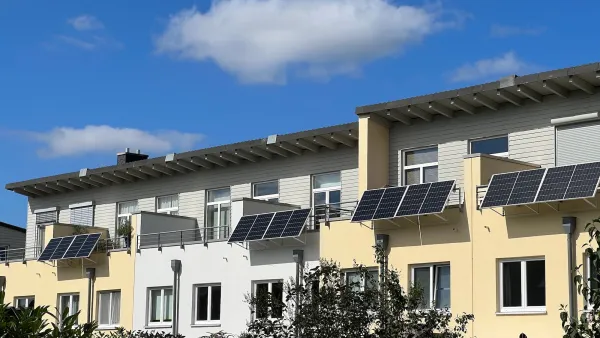
28 States and DC Could Legalize ‘Balcony Solar’
Plug-in solar panels, which are becoming popular across Europe, live in a regulatory gray area in the United States.
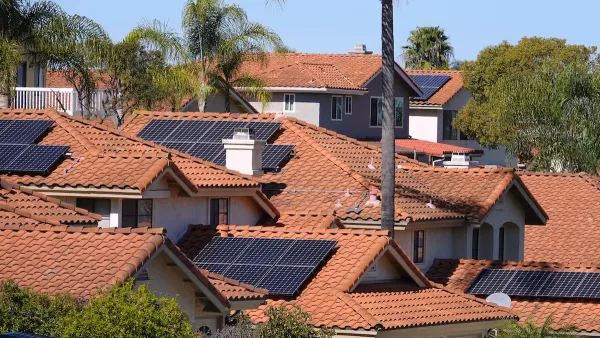
California Leads in Solar Rooftops
A combination of state and local incentives and building code mandates has helped California far outpace other states in residential rooftop solar permits.

Rooftop Solar on Mexico City Market to Power 300 Transit Buses
A solar project atop a massive food market will provide electricity to Mexico City's public transit buses.

Planetizen Federal Action Tracker
A weekly monitor of how Trump’s orders and actions are impacting planners and planning in America.

The state-sanctioned urbicide of Austin
People don’t kill cities. Freeways do.

US to reduce Colorado River water deliveries to Mexico
A new Colorado Treaty amendment reduces Mexico’s Colorado River water allocation by 250,000 acre feet.

5 New England states march closer to 800 megawatt wind energy project
Securing federal approval for the project may be complicated under the Trump administration, which has historically been hostile towards domestic wind power.

Baltimore to break ground on $50 million Transit Priority Project
The project will bring faster bus trips, safer streets and better bike connections to Baltimore.

Airbnb launches $250 million 'last-dollar financing' housing accelerator, makes first investment in Austin
The company will put $6.4 million towards affordable housing development in Texas’ capital.

FREE Course: Walkable City 1: Why Walkability?
After describing his path towards focusing on walkability as the essence of good planning, Jeff Speck marches through his five principal reasons for making more walkable places.
Reinventing Malls: Planning Alchemy—Turning Gray Fields Into Gold
The course focuses on the opportunities and imperatives that shape reinvention of mall sites.

Eagle County Government
Harvard University Graduate School of Design
Nashville Planning Department
The Architects Foundation
University of Cincinnati Online
The Pocatello Development Authority
The Urban Renewal Agency of the City of Pocatello
Journal of the American Planning Association