An Ohio land bank adds to its developing power through a community land trust.


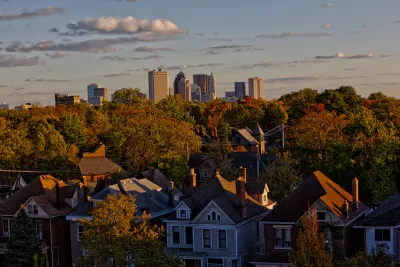
Miguel Lopez Perez rented his first apartment as an undergraduate student in Columbus, Ohio, in 2004. He remembers his first rental—a two-bedroom that cost around $600 monthly. When he decided to pursue a Ph.D. program in biochemistry at Ohio State University, his last rental was a two-bedroom duplex that cost $1,200 monthly in 2020. Homeownership was something he had never experienced. His parents had always rented when they moved to the United States, whether they lived in California or in Ohio. “We get stipends as students, but it’s not anywhere near the kind of money that would allow me to think seriously about being a homeowner,” he says.
But his life as a tenant changed in 2020. While casually browsing Zillow, he came across a newly constructed single-family home listed as an “income-restricted” property at $185,000. The label caught his eye because it was such a new house. “I thought there had to be an additional catch,” Lopez says.
After a little research, he found there wasn’t a gimmick. The house was built by the Central Ohio Community Land Trust (COCLT), a 501(c)(3) organization created in 2018 as a subsidiary of the Central Ohio Community Improvement Corporation (COCIC), Franklin County’s land bank formed in 2012. The home he was looking at was part of a plan by local authorities to integrate homeownership into its affordable housing solutions in Franklin County, of which Columbus is the county seat.
While it’s very common for local governments to start a land bank, and smaller grassroots groups to form land trusts, the all-in-one structure is rare. The Center for Community Progress highlights this subsidiary model in its report on land bank and land trust partnerships.
In the traditional real estate market, homebuyers are expected to make a down payment, often 20 percent of the purchase price, and be approved for a mortgage. The median price of a home in Columbus, Ohio, is about $250,000, meaning a downpayment is around $50,000. In a typical mortgage, a homeowner repays their home loan to the bank to own the property in its entirety. In a typical equity model, if a homeowner is halfway into their 30-year mortgage, they own 50 percent of their property. By the end of their mortgage, the home is theirs.
See source article to continue reading.
FULL STORY: When a Land Bank Starts a Land Trust

Community Land Trusts Offer Relief From High Housing Costs
The nonprofit model is becoming more popular as communities seek ways to reduce housing costs.

Community Land Trusts Make Homeownership Accessible
The organizations sell homes to low-income buyers at rates far below market prices, putting homeownership within reach for more families.
Report: Housing is becoming an 'inherited advantage'
As housing costs soar, buying a home is becoming unaffordable to a large swath of American families.

The state-sanctioned urbicide of Austin
People don’t kill cities. Freeways do.

US to reduce Colorado River water deliveries to Mexico
A new Colorado Treaty amendment reduces Mexico’s Colorado River water allocation by 250,000 acre feet.

New Jersey’s second-largest city bans standalone data centers
Jersey City will continue to allow co-location facilities, such as those meant for research institutions that store their own data.

Amtrak not solely to blame for New Jersey commuter rail's unreliability, report finds
A new study from the Garden State Initiative found that NJ Transit’s budget grew 20% across a 4 year period, but reliability declined significantly over the same period.

EPA erases limits on planet-warming pollution from power plants
Under Monday’s plan, power plants would still have some limits on how much mercury, arsenic and other contaminants they can emit.

Phoenix announces new on-demand transit service, more frequent RAPID buses
Both new services will launch in October, and are part of Phoenix's Project Effective Access Solutions for Easing Congestion.

FREE Course: Walkable City 1: Why Walkability?
After describing his path towards focusing on walkability as the essence of good planning, Jeff Speck marches through his five principal reasons for making more walkable places.
Reinventing Malls: Planning Alchemy—Turning Gray Fields Into Gold
The course focuses on the opportunities and imperatives that shape reinvention of mall sites.

Eagle County Government
Harvard University Graduate School of Design
Nashville Planning Department
The Architects Foundation
University of Cincinnati Online
The Pocatello Development Authority
The Urban Renewal Agency of the City of Pocatello
Journal of the American Planning Association