The rising cost of housing, along with the pandemic, has transformed the lack of housing affordable to teachers in expensive parts of California from bad to worse. Solutions so far only address half the problem or don’t go far enough.



The increasing gap between teacher salaries and the cost of owning or renting a home are making it increasingly hard for teachers to make ends meet. To afford the cost of living, many teachers are forced to work an extra job, commute long distances, or rely on in housing provided by their school districts.
A recent article by Edwin Rios for the Guardian focuses on California as the poster child of the teacher workforce housing affordability problem, but also as a case study of early policy responses to the challenge—a challenge is exacerbated on both sides of an equation found in other parts of the country as well. The cost of housing is rising, and teachers are significantly underpaid relative to other jobs.
Research published by the Economic Policy Institute in August 2022 “found that public school teachers nationally make nearly 24% less in weekly earnings than similarly credentialed college graduates in other fields,” explains Rios. “When benefits such as healthcare were taken into account, the total compensation penalty was 14%, the widest gap since 1979.”
After laying out the scale of a problem that cuts across issues of land use, racial demographics, and numerous social outcomes, the article also digs into how some governments, at various levels, are responding to the challenge. “In California, Governor Gavin Newsom signed a bill last October that would make it easier for districts to build housing specifically for teachers and school employees on district-owned properties beginning January 2024,” for example. According to an “Education Workforce Housing” report published by the California School Boards Association (CSBA) in collaboration with researchers at the University of California, Los Angeles and the University of California, Berkeley; more than 40 districts around the state of California are considering workforce housing projects.
The potential for school districts to provide more workforce housing is far greater that has been realized. Local educational agencies in California own 151,500 acres of land, for example, according to the press release announcing the study. But the article never strays to far from the idea that solutions to teacher workforce housing challenges will also have to ensure that teacher salaries are competitive enough to attract the talent and work ethic required of the job.
FULL STORY: US teachers grapple with a growing housing crisis: ‘We can’t afford rent’

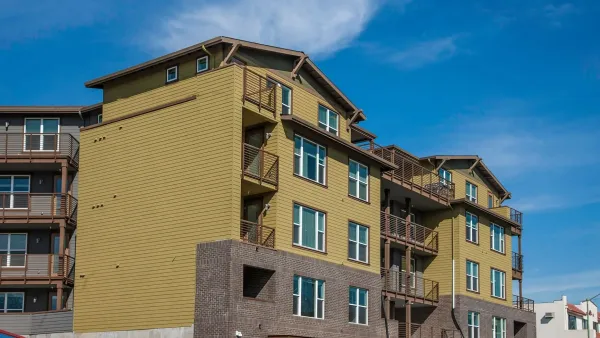
Oakland opens first affordable housing for teachers
The school district says 70% of its teachers can't afford to live in Oakland.
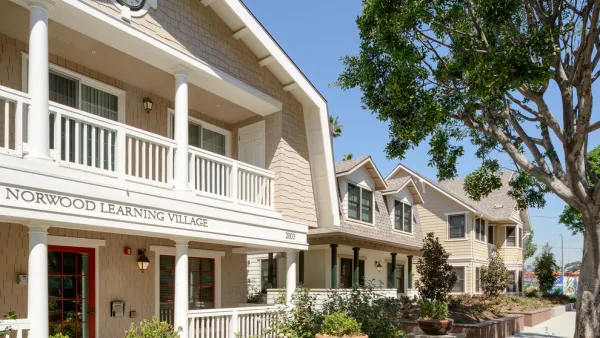
Teachers Make 5% Less Than a Decade Ago. These Districts are Building Housing for Them
The housing crisis is hitting education workers particularly hard, making it difficult to find housing near their workplaces.
Iowa City Hopes Zoning Amendments Will Increase Housing Supply, Diversity
Iowa City is planning ahead to ensure that housing supply keeps up with housing demand.

Planetizen Federal Action Tracker
A weekly monitor of how Trump’s orders and actions are impacting planners and planning in America.

The state-sanctioned urbicide of Austin
People don’t kill cities. Freeways do.

US to reduce Colorado River water deliveries to Mexico
A new Colorado Treaty amendment reduces Mexico’s Colorado River water allocation by 250,000 acre feet.

5 New England states march closer to 800 megawatt wind energy project
Securing federal approval for the project may be complicated under the Trump administration, which has historically been hostile towards domestic wind power.

Baltimore to break ground on $50 million Transit Priority Project
The project will bring faster bus trips, safer streets and better bike connections to Baltimore.

Airbnb launches $250 million 'last-dollar financing' housing accelerator, makes first investment in Austin
The company will put $6.4 million towards affordable housing development in Texas’ capital.

FREE Course: Walkable City 1: Why Walkability?
After describing his path towards focusing on walkability as the essence of good planning, Jeff Speck marches through his five principal reasons for making more walkable places.
Reinventing Malls: Planning Alchemy—Turning Gray Fields Into Gold
The course focuses on the opportunities and imperatives that shape reinvention of mall sites.

Eagle County Government
Harvard University Graduate School of Design
Nashville Planning Department
The Architects Foundation
University of Cincinnati Online
The Pocatello Development Authority
The Urban Renewal Agency of the City of Pocatello
Journal of the American Planning Association