Recent proposals that would reward citizens for reporting bike lane violations could further damage social cohesion and create a ‘narc economy.’


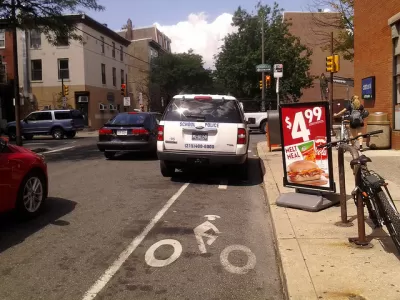
In an opinion piece for Streetsblog NYC, MJ Barnett cautions against ‘narc urbanism,’ the emerging trend of new laws that essentially put a bounty on reporting illegal behavior such as blocking a bike lane.
In New York City, a proposed law would let residents earn a percentage of citation revenue if they report a blocked bike lane, a proposal similar to an existing law that created a similar program for reporting idling trucks to prevent air pollution.
For Barnett, this ‘citizen-led surveillance’ is not the solution.
American society is already fractious enough: interpersonal trust is sharply deteriorating as real-world social networks decline, and rising distrust in our institutions and media make consensus increasingly challenging. Bills like Intro 501 further the trend toward mutual mistrust, hardening existing us-versus-them dynamics in our shared public spaces by creating a narc economy with serious financial incentives and penalties.
Such laws, Barnett argues, are a perversion of Jane Jacobs’ ‘eyes on the street’ concept, turning mutual protection into vigilante justice. Additionally, “Deputizing citizens to address traffic violations also implicates the many ethical issues attendant to privatized and citizen-led law enforcement,” pointing to America’s “long history of errant and racially biased community policing.”
As Barnett points out, blocking a bike lane is already illegal. Laws like Intro 501 allows the NYPD to shirk its duties and pass off responsibility to ordinary citizens rather than address the root problem. To solve urban problems, Barnett argues, “we’re going to need leaders willing to leverage the power of the state to do what’s right, even when it’s difficult.”
Read the full story: Opinion: Here’s Why I am Against ‘Narc Urbanism’

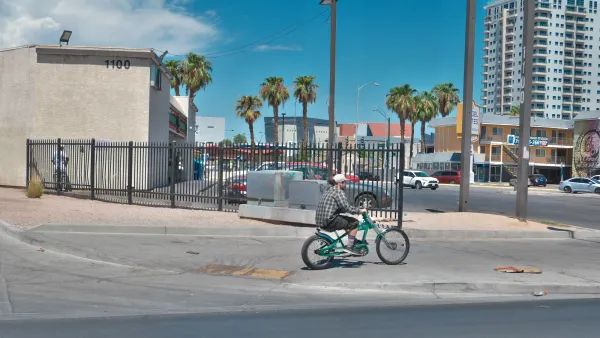
Las Vegas is building its first protected bike lane
The new lane connects Henderson and the Las Vegas Raiders headquarters via Starr Avenue.

Nashville installs concrete barriers to protect bike lanes
The new 'Toronto barriers' provide a physical buffer between cars and bike lanes.
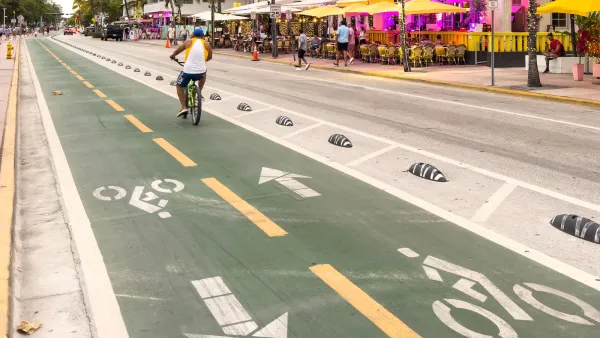
FHWA removes bike lanes and speed cameras from list of traffic safety measures
The agency did not announce its intention to eliminate five proven safety measures from its list of suggested interventions.

Planetizen Federal Action Tracker
A weekly monitor of how Trump’s orders and actions are impacting planners and planning in America.

The state-sanctioned urbicide of Austin
People don’t kill cities. Freeways do.

Colorado’s Largest Data Center Could Rise Next to Homes — Without a Public Hearing
The proposed campus would consume 11 times the power of Denver International Airport; as it has across the country, opposition mounts.

Judges permit Denver to divert 77,000 acre feet from the Colorado River for reservoir expansion
Overuse and climate change have caused the Colorado River’s water levels to plummet.
Amtrak, CN end decades-long dispute with eight-year agreement
The new operating agreement establishes an updated framework for the companies to work together, including processes to resolve disputes.
Raised interest rates may kill financially vulnerable construction projects
The chief economist at ConstructConnect warns that if construction project owners are negatively impacted by the raised rates, it could result in delayed payments to contractors.

FREE Course: Walkable City 1: Why Walkability?
After describing his path towards focusing on walkability as the essence of good planning, Jeff Speck marches through his five principal reasons for making more walkable places.
Reinventing Malls: Planning Alchemy—Turning Gray Fields Into Gold
The course focuses on the opportunities and imperatives that shape reinvention of mall sites.

KFH Group Inc.
Greater Baltimore Committee
Eagle County Government
The Architects Foundation
University of Cincinnati Online
The Pocatello Development Authority
The Urban Renewal Agency of the City of Pocatello