While the historic agreement set a new precedent for water rights, its inherent flaws, growing demand, and the threat of climate change make much of it obsolete for today’s needs.


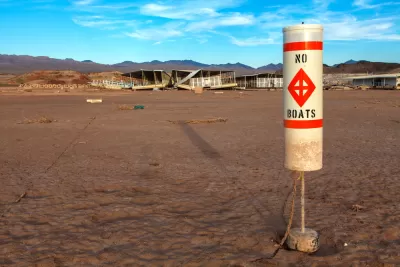
The first treaty in U.S. history to bring together more than two states, the Colorado River Compact turns one hundred this month. But, as Jonathan Thompson writes in High Country News, the historic seven-state agreement is “showing its age,” no longer a viable document for addressing the water shortage facing communities along the Colorado River today.
The article analyzes the compact’s history, its most relevant provisions, and how today’s policymakers can redress the mistakes made in those early days and plan for a more resilient future. The treaty was full of holes from the beginning, Thompson explains. “Tribal nations were not only left out of the Compact and negotiations, but their senior and therefore stronger water rights were discounted altogether.” Thompson asserts that “The exclusion was far worse than a gross oversight; it was a blatant attack on tribal sovereignty.”
Thompson adds that the compact was based on flawed or purposely misleading assumptions about water supplies and needs. Yet “The document’s framers never even considered the possibility that the river’s flows would diminish over time, as is now the case thanks to climate-change-induced aridification.” The original document allocated 16 million acre-feet of water “in perpetuity” to irrigation, calling it 80 percent of the river’s flow, a conscious overestimate even at the time.
According to Thompson, “Now that it’s reaching its centennial, perhaps it’s time for the Colorado River Compact to retire, and for the river’s users — all of them — to sit down and negotiate a new pact for a changing world.”
FULL STORY: On its 100th birthday, the Colorado River Compact shows its age

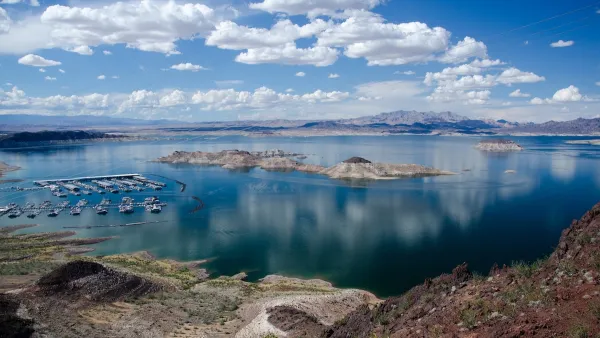
Colorado River States Inch Closer to Agreement
Upper Basin and Lower Basin states each say their plan for conserving the Colorado River’s water is the most sustainable.
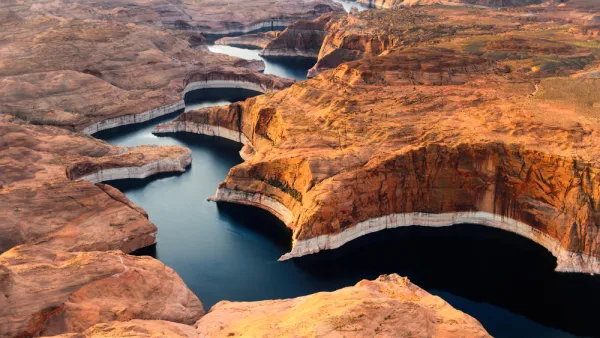
California Rejects Six-State Colorado River Plan, Proposes Its Own
State officials claim a proposal agreed upon by the other six states using Colorado River water disproportionately impacts California farmers.
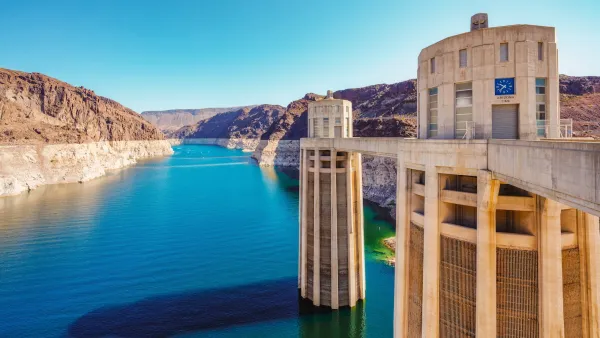
Federal proposal calls for mandatory water cuts to Arizona, California and Nevada
The Bureau of Reclamation stepped in after states failed to come to an agreement over Colorado River water use reductions.

The state-sanctioned urbicide of Austin
People don’t kill cities. Freeways do.

US to reduce Colorado River water deliveries to Mexico
A new Colorado Treaty amendment reduces Mexico’s Colorado River water allocation by 250,000 acre feet.

New Jersey’s second-largest city bans standalone data centers
Jersey City will continue to allow co-location facilities, such as those meant for research institutions that store their own data.

Amtrak not solely to blame for New Jersey commuter rail's unreliability, report finds
A new study from the Garden State Initiative found that NJ Transit’s budget grew 20% across a 4 year period, but reliability declined significantly over the same period.

EPA erases limits on planet-warming pollution from power plants
Under Monday’s plan, power plants would still have some limits on how much mercury, arsenic and other contaminants they can emit.

Phoenix announces new on-demand transit service, more frequent RAPID buses
Both new services will launch in October, and are part of Phoenix's Project Effective Access Solutions for Easing Congestion.

FREE Course: Walkable City 1: Why Walkability?
After describing his path towards focusing on walkability as the essence of good planning, Jeff Speck marches through his five principal reasons for making more walkable places.
Reinventing Malls: Planning Alchemy—Turning Gray Fields Into Gold
The course focuses on the opportunities and imperatives that shape reinvention of mall sites.

Eagle County Government
Harvard University Graduate School of Design
Nashville Planning Department
The Architects Foundation
University of Cincinnati Online
The Pocatello Development Authority
The Urban Renewal Agency of the City of Pocatello
Journal of the American Planning Association