With the prison complex slated to close by 2027, the city has an opportunity to transform the island into a renewable energy and research hub.


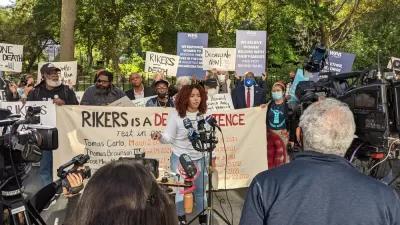
Writing in Time Out, Anna Rahmanan describes one possible future of New York’s notorious Rikers Island, which has served as a prison since 1932 and has become notorious for poor conditions and the violent treatment of prisoners. In 2019, the City Council voted to close the main prison complex, making way for new uses that could include sustainable energy and waste facilities.
“Last week, the Regional Plan Association and Rhode Island School of Design released a report based on the vision of the Renewable Rikers coalition—composed of folks that were formerly incarcerated on Rikers, plus their families and environmental and social justice groups—outlining their plans to transform the area into a green energy center.” The report proposes a research and training facility for formerly incarcerated people, a wastewater treatment plant, and recycling facilities.
According to Rahmanan, “The latter hub could potentially process over 365,000 tons of organic waste each year while also decreasing the amount of pollution currently produces by trucks on the road—that's in an of itself a huge deal.” Meanwhile, the wastewater treatment plant would replace similar facilities now located in Queens and the Bronx.
Andrea Johnson, assistant professor in the Master of Landscape Architecture program at the Rhode Island School of Design, said in a statement, “The carefully thought out designs we've presented in this report show how the entire island can be activated as an energy hub for all of New York City, while freeing large swathes of neighboring boroughs from aging energy infrastructure.”
Read the full story: See what Rikers Island could look like when the prison complex closes

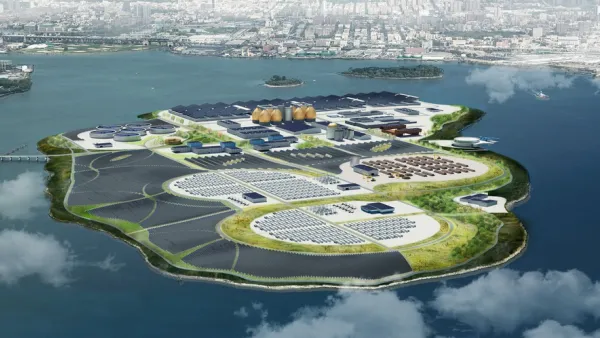
Can New York City Go Green Without Renewable Rikers?
New York City’s bold proposal to close the jail on Rikers Island and replace it with green infrastructure is in jeopardy. Will this compromise the city’s ambitious climate goals?
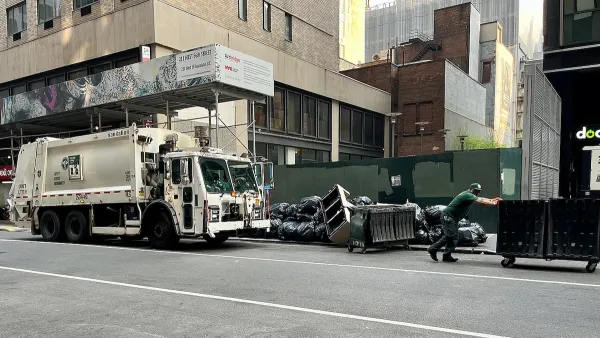
Parked Cars Hamper NYC Trash Containerization Effort
Sanitation workers must manually collect bags from containers blocked by parked cars, slowing a process that is meant to be safer and more efficient.
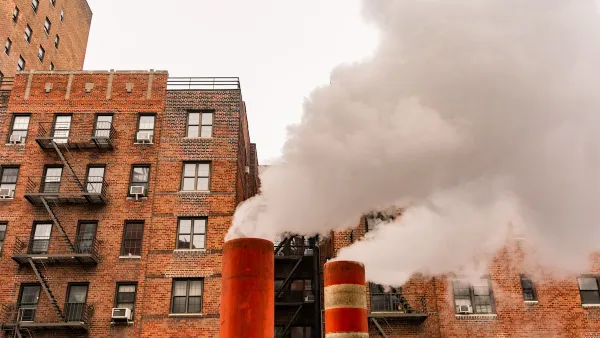
“Steam Loops” Can Power Large Buildings With Clean Energy
Underground steam pipe systems in New York, Boston, and other cities could hold the key to renewable power generation.

Planetizen Federal Action Tracker
A weekly monitor of how Trump’s orders and actions are impacting planners and planning in America.

The state-sanctioned urbicide of Austin
People don’t kill cities. Freeways do.

US to reduce Colorado River water deliveries to Mexico
A new Colorado Treaty amendment reduces Mexico’s Colorado River water allocation by 250,000 acre feet.

Nation's most wind-powered state turns to coal as data centers increase energy demand
For the first time in decades, Iowa has increased its generation of coal power.

NYC cools commuters with city's first rain garden above a bus stop
New York City officials say the plants in the rain garden can absorb 16 gallons of rainwater during heavy storms.

Brightline West’s future may rely on $6 billion federal loan
The company has until Nov. 2 to make a $400 million equity investment into its proposed high-speed rail line.

FREE Course: Walkable City 1: Why Walkability?
After describing his path towards focusing on walkability as the essence of good planning, Jeff Speck marches through his five principal reasons for making more walkable places.
Reinventing Malls: Planning Alchemy—Turning Gray Fields Into Gold
The course focuses on the opportunities and imperatives that shape reinvention of mall sites.

Eagle County Government
Harvard University Graduate School of Design
Nashville Planning Department
The Architects Foundation
University of Cincinnati Online
The Pocatello Development Authority
The Urban Renewal Agency of the City of Pocatello
Journal of the American Planning Association