The race for the county’s only board seat pits proponents of ‘missing middle housing and higher density against residents concerned about outsized growth.


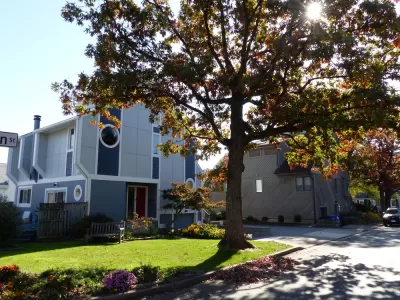
The election for a seat on Northern Virginia’s Arlington County Board is quickly becoming a referendum on housing density, writes Teo Armus in the Washington Post.
“As he campaigns for reelection, first-term board member Matt de Ferranti (D) has seemingly tried to stake a compromise position on missing middle, which is set to be voted on by county lawmakers early next year.” His opponents skew to the opposite ends of the spectrum, with Audrey Clement campaigning on concerns about density coming too quickly and Adam Theo calling on the county to do more to address its deepening housing shortage.
“That has left de Ferranti — one of the most liberal voices on an already liberal board — somewhere in the middle, trying to build consensus on a divisive topic with a middle-of-the-road solution that seems to make no one happy,” Armus writes. “The only board member to vocally oppose blanket legalization of eight-unit apartment buildings, he has echoed some talking points from those critics [of growth], saying that these ‘eightplexes’ would mostly result in one-bedroom rentals more vulnerable to developer speculation.”
With the Democratic party’s backing a significant financial advantage, de Ferranti is expected to win reelection, but the campaign has brought out stark divides over the housing density question among local residents.
Read the full story: Arlington’s sole county board race a proxy war over ‘missing middle’


Arlington ‘Missing Middle Housing’ Plan Faces Scrutiny
A proposal to legalize more housing types in northeastern Virginia has prompted vigorous debate among stakeholders.
Decatur Moves Closer to Legalizing Duplexes, ‘Missing Middle Housing’
A proposal to permit multifamily housing units in areas previously zoned for single-family homes passed its first hurdle, but requires a second vote to go into effect.

Eugene Approves ‘Missing Middle Housing’
The city council voted to approve an ordinance that will permit more middle housing types in single-family neighborhoods.

Planetizen Federal Action Tracker
A weekly monitor of how Trump’s orders and actions are impacting planners and planning in America.

The state-sanctioned urbicide of Austin
People don’t kill cities. Freeways do.

US to reduce Colorado River water deliveries to Mexico
A new Colorado Treaty amendment reduces Mexico’s Colorado River water allocation by 250,000 acre feet.

Brightline West’s future may rely on $6 billion federal loan
The company has until Nov. 2 to make a $400 million equity investment into its proposed high-speed rail line.

LA Metro’s ultimatum: no extra buses for LA28 if federal funding isn’t imminently secured
If Metro does not provide additional buses, LA28 organizers will have to find a new way to manage Olympic traffic. LA28’s budget does not include a line item for transit.

Colorado’s Largest Data Center Could Rise Next to Homes — Without a Public Hearing
The proposed campus would consume 11 times the power of Denver International Airport; as it has across the country, opposition mounts.

FREE Course: Walkable City 1: Why Walkability?
After describing his path towards focusing on walkability as the essence of good planning, Jeff Speck marches through his five principal reasons for making more walkable places.
Reinventing Malls: Planning Alchemy—Turning Gray Fields Into Gold
The course focuses on the opportunities and imperatives that shape reinvention of mall sites.

Eagle County Government
Harvard University Graduate School of Design
Nashville Planning Department
The Architects Foundation
University of Cincinnati Online
The Pocatello Development Authority
The Urban Renewal Agency of the City of Pocatello
Journal of the American Planning Association