The state assembly has asked the department of transportation to begin research and planning for a rapid transit line that would connect residents with jobs in Washington, D.C. and reduce traffic congestion in the region.


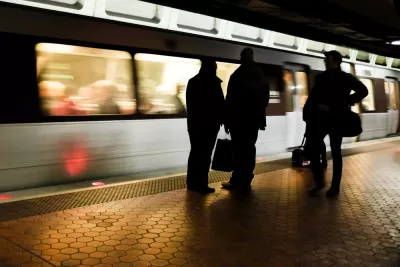
Southern Maryland workers may soon have more public transit options. Well, as soon as the state can “undertake all steps necessary to complete the design, engineering, and [environmental] process and secure a record of decision for the Southern Maryland Rapid Transit Project.”
According to an article by Bruce DePuyt in Maryland Matters, “Transportation experts have spent decades looking at the feasibility of building a transit line to serve Southern Maryland, but projects in other parts of the state always loomed larger in the eyes of policymakers.” Now, the General Assembly has tasked the state’s Department of Transportation with moving forward on a transit plan, thanks in part to $5 million federal earmark secured by state lawmakers. The article quotes State Senator Arthur Ellis (D-Charles), who says that 77 percent of the region’s working adults regularly commute to Washington, D.C., adding that they face the “worst commute in the nation.”
The project was recommended by a 2017 analysis, which “concluded that an 18.7 mile bus rapid transit system along the US 301/MD 5 corridor, from White Plains in Charles County to the Branch Avenue Metrorail Station in Prince George’s County, would be more cost-effective than light rail.” The report also supported transit-oriented development (TOD), adding, “TOD will provide higher land use density/intensity, help increase transit ridership to maximize transit investment, encourage economic growth and job creation, reduce the jobs-to-housing imbalance along the MD 5/US 301 corridor, and promote alternative transportation modes (e.g., walking, biking, transit) to reduce or eliminate the need to commute via automobile.”
Read the full story: For the first time, Southern Maryland’s transit dreams are showing signs of life
Big Transit Projects To Look Forward to in 2022
An exhaustive list of all fixed-guideway projects scheduled to open or break ground in the U.S. in 2022.
Detroit Ballot Measure Puts Regional Transit in Reach
Involving four counties and $4.6 billion, the measure proposes a system that could put a million residents (and a million jobs) within a quarter mile of transit.

Despite 47% growth in ridership, Caltrain could close a third of its stations
Riders can currently travel up to 79 miles between San Francisco and Gilroy, California.

Planetizen Federal Action Tracker
A weekly monitor of how Trump’s orders and actions are impacting planners and planning in America.

California plans to bury El Niño’s downpour
If the state plays its cards right, it may be able to store a billion acre-feet of El Niño’s water in aquifers.

Desperate measures: Advocates weigh draining Lake Powell to fill Colorado River
Draining the reservoir could reduce evaporation losses by a couple hundred thousand acre-feet.

Chicago voters approve permanent festival grounds, penalty for vacant property owners
Currently, major summer and fall festivals take over public parks for weeks at a time, drawing criticism from nearby residents

NYC votes to cut outdoor dining red tape, speed up permitting
New York City also voted to allow the Department of Transportation to begin work on urgent projects before notifying elected officials.

California appears to reject Prop. 45
The proposition would have expanded the projects that qualify for a streamlined environmental review, effectively paring down the California Environmental Quality Act.

FREE Course: Walkable City 1: Why Walkability?
After describing his path towards focusing on walkability as the essence of good planning, Jeff Speck marches through his five principal reasons for making more walkable places.
Reinventing Malls: Planning Alchemy—Turning Gray Fields Into Gold
The course focuses on the opportunities and imperatives that shape reinvention of mall sites.

City of Rosemead
Rutgers University, Edward J. Bloustein School of Planning and Public Policy
One Hundred Miles
Hunter College, City University of New York (CUNY)
The Architects Foundation
University of Cincinnati Online
City of Cambridge
Montrose County
The Pocatello Development Authority