As commercial storefronts experience high vacancy rates, cities like Oakland and San Francisco are making concerted efforts to support temporary tenants, public art installations, and small entrepreneurs that can revitalize abandoned spaces.


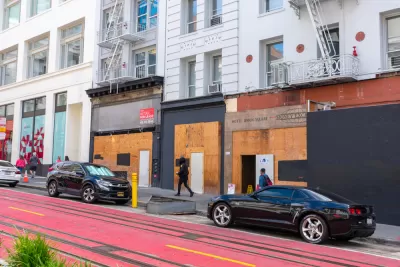
As stories from around the country attest, the last two and a half years accelerated a hollowing-out of central business districts in many U.S. cities. Regardless of how quickly the pandemic officially ends, writes John King in a paywalled article in the San Francisco Chronicle, “What cities and building owners must do now is find intriguing, inventive ways to plug holes on a short-term basis — so that today’s terrain of ‘for rent’ signs doesn’t become a permanent blight on too many urban blocks.”
King argues that “Cities need to find ways to prime the pump, and facilitate new types of ongoing activities within otherwise vacant ground floor spaces.” Kate Sofis, director of the San Francisco Office of Economic and Workforce Development, agrees. As King writes, “One promising initiative comes out of Sofis’ office: ‘Vacant to Vibrant,’ which would allocate $750,000 in the 2022-23 city budget to ‘pairing property owners with artists and small businesses who can use the space for short term activations.’”
King imagines even more possibilities: “Imagine if civic or cultural institutions committed to programming a year of exhibitions in a spacious storefront near Salesforce Tower, one after the other, each showcasing a niche within their collection.” Or “City Hall itself could commit to a storefront that would function as a service center — an easy spot for residents to get assistance face to face.”
“It also makes sense to loosen the definition of what is allowed along could-be-busy sidewalks,” King writes, pointing to the city of Oakland’s experiment in doing just that. Across the bay, “San Francisco’s proposed budget next year includes $2.5 million for special events and streetscape improvements in what the city calls the ‘economic core.’ The goal: to ‘draw a wide range of both business and leisure visitors over the course of a week.’ And give them a reason to stop by more than once.”
FULL STORY: Can pop-ups save downtown San Francisco? How Bay Area cities are trying to revive empty storefronts

How To Slow the Wave of Commercial Vacancies
Empty storefronts depress property values and suppress small business growth. What can cities do to fill these vacancies?

With Zero Office Conversions in Four Years, San Francisco Pins Hopes on New Special Financing District
City leaders hope the new incentive will spur the redevelopment of some of the city’s 30,000 square feet of vacant office space into housing.
How to Repurpose Vacant Storefronts
Loosening restrictions on clean light manufacturing can revive dormant storefronts and revitalize communities.

The state-sanctioned urbicide of Austin
People don’t kill cities. Freeways do.

US to reduce Colorado River water deliveries to Mexico
A new Colorado Treaty amendment reduces Mexico’s Colorado River water allocation by 250,000 acre feet.

New Jersey’s second-largest city bans standalone data centers
Jersey City will continue to allow co-location facilities, such as those meant for research institutions that store their own data.

Amtrak not solely to blame for New Jersey commuter rail's unreliability, report finds
A new study from the Garden State Initiative found that NJ Transit’s budget grew 20% across a 4 year period, but reliability declined significantly over the same period.

EPA erases limits on planet-warming pollution from power plants
Under Monday’s plan, power plants would still have some limits on how much mercury, arsenic and other contaminants they can emit.

Phoenix announces new on-demand transit service, more frequent RAPID buses
Both new services will launch in October, and are part of Phoenix's Project Effective Access Solutions for Easing Congestion.

FREE Course: Walkable City 1: Why Walkability?
After describing his path towards focusing on walkability as the essence of good planning, Jeff Speck marches through his five principal reasons for making more walkable places.
Reinventing Malls: Planning Alchemy—Turning Gray Fields Into Gold
The course focuses on the opportunities and imperatives that shape reinvention of mall sites.

Eagle County Government
Harvard University Graduate School of Design
Nashville Planning Department
The Architects Foundation
University of Cincinnati Online
The Pocatello Development Authority
The Urban Renewal Agency of the City of Pocatello
Journal of the American Planning Association