Questions of density, and how to add it to single-family neighborhoods, abound in this article focusing on Honolulu and other communities on Oahu.


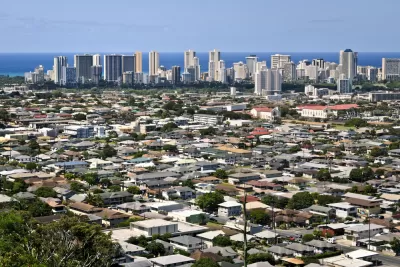
Stewart Yerton reports for Honolulu Civil Beat on the growing controversies surrounding large homes, built as multi-family dwellings, in traditionally single-family neighborhoods in Oahu.
The article commences with the controversy created by a proposed development for a nine-bedroom house designed to house workers in the Pacific Heights area of Honolulu, home to historic houses and affluent neighbors. Yerton explains the zoning conundrum presented by the home:
The problem is the house was going to be in a quiet residential neighborhood of historic homes. And even if the structure technically met the density criteria allowed by Honolulu’s land-use ordinance, its apparent intended use – as essentially an apartment building or dormitory – simply wouldn’t be allowed in a place zoned for single-family homes.
The development proposal caught the attention of Patrick Smith, president of the Nuuanu/Punchbowl Neighborhood Board, which has an oversight role for the project as part of Oahu’s Neighborhood Board System, established in 1973. "We don’t want our neighborhood having apartment buildings," Smith is quoted as saying in the article.
The neighborhood board succeeded in killing the project, reports Yerton, but the example is far from the only residential development controversy on the island. Residents and policymakers across Oahu are rejecting multi-room houses, "known as 'monster homes,'" amidst a surge in housing costs. The question of how to add density on the island is unanswered, according to the article.
Previous efforts include Bill 7, adopted by the Hawaii State Legislature in 2019. According to Yerton, the bill's incentives for density in the form of redeveloped small homes and under-used, walk-up apartment buildings applies to 7,000 properties in the state but has produced zero new projects. More on Bill 7 is available from an article by Noelle Fujii-Oride for Hawaii Business, published earlier in February 2022.
The source article, linked below, goes into feature depth on the housing development and zoning specifics in Hawaii and Oahu, as well as one architect who recently managed to navigate the Bill 7 "gauntlet."
FULL STORY: More Housing In Honolulu Means More Density. Are Monster Homes The Only Way?

Balancing Aesthetics and Affordability
Policies too narrowly focused on design can drive up the cost of construction and prevent the development of affordable housing.
The 'Most Pro-Housing Reform in U.S. History' Expected for Approval Today in Portland
The Portland Residential Infill Project is expected for approval by the Portland City Council today, culminating a six year process that became more and more ambitious with every iteration.

Birthplace of Single-Family Zoning Poised to Pass Upzoning Plan
Berkeley, California, pioneered exclusionary zoning in the early 1900s; with its new upzoning proposal, the city hopes to reverse that negative legacy and boost its housing supply by eliminating single-family zoning.

The state-sanctioned urbicide of Austin
People don’t kill cities. Freeways do.

US to reduce Colorado River water deliveries to Mexico
A new Colorado Treaty amendment reduces Mexico’s Colorado River water allocation by 250,000 acre feet.

New Jersey’s second-largest city bans standalone data centers
Jersey City will continue to allow co-location facilities, such as those meant for research institutions that store their own data.

Amtrak not solely to blame for New Jersey commuter rail's unreliability, report finds
A new study from the Garden State Initiative found that NJ Transit’s budget grew 20% across a 4 year period, but reliability declined significantly over the same period.

EPA erases limits on planet-warming pollution from power plants
Under Monday’s plan, power plants would still have some limits on how much mercury, arsenic and other contaminants they can emit.

Phoenix announces new on-demand transit service, more frequent RAPID buses
Both new services will launch in October, and are part of Phoenix's Project Effective Access Solutions for Easing Congestion.

FREE Course: Walkable City 1: Why Walkability?
After describing his path towards focusing on walkability as the essence of good planning, Jeff Speck marches through his five principal reasons for making more walkable places.
Reinventing Malls: Planning Alchemy—Turning Gray Fields Into Gold
The course focuses on the opportunities and imperatives that shape reinvention of mall sites.

Eagle County Government
Harvard University Graduate School of Design
Nashville Planning Department
The Architects Foundation
University of Cincinnati Online
The Pocatello Development Authority
The Urban Renewal Agency of the City of Pocatello
Journal of the American Planning Association