The U.S. Department of Housing and Urban Development's "2021 Annual Homeless Assessment Report" comes with significant caveats about partial data and changing homeless shelter practices.



The U.S. Department of Housing and Urban Development (HUD) released its 2021 Annual Homeless Assessment Report (AHAR) Part 1 to Congress on Friday, February 4, 2022. Part 1 of the AHAR provides Point-in-Time (PIT) estimates, offering a snapshot of homelessness on a single night. Part 2 provides estimates of homelessness in the United States, but HUD has not produced a Part 2 of the report since 2018, due to the Covid-19 pandemic, according to the HUD Exchange website.
According to a February 4 HUD press release, the report counts more than 326,000 people experiencing sheltered homelessness in the United States on a single night in 2021. The figure represents an eight percent decrease from 2020. "'Sheltered homelessness' refers to people experiencing homelessness who were found in emergency shelters, transitional housing, or other temporary settings," according to the press release.
HUD did not require communities to count unsheltered homeless in 2021 due to the public health concerns of the Covid-19 pandemic. A count of unsheltered homeless is reported in the AHAR, but with the caveat of the reported total being an estimate based on partial data. With that caveat in mind, the number of unsheltered homeless stayed relatively flat in 2021 compared to 2020.
The pandemic resulted in considerable changes to the practices of homeless service providers. "To promote the safety of people staying in shelter programs, most emergency shelters reduced occupancy to respond to CDC recommendations on COVID-19 safety measures," according to the press release. Those changes warrant caution about comparing Part 1 of this year's report to previous years.
HUD Secretary Marcia L. Fudge is quoted in the press release touting the results of the report. "The findings of the 2021 AHAR Part 1 report suggest that federal COVID-19 relief had positive impacts on sheltered homelessness," said Secretary Fudge.
FULL STORY: HUD Releases 2021 Annual Homeless Assessment Report Part 1

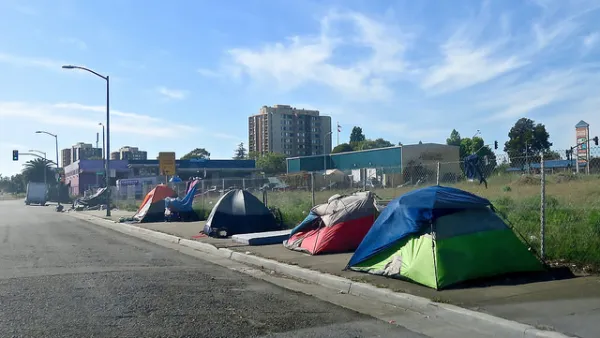
Report: Homelessness on the Rise in the United States, Again
A new federal report finds a few reasons for optimism in a nationwide homeless count, but the numbers of homeless in the United States have grown for the second year in a row.

New State Study Suggests Homelessness Far Undercounted in New Mexico
An analysis of hospital visit records provided a more accurate count than the annual point-in-time count used by most agencies.
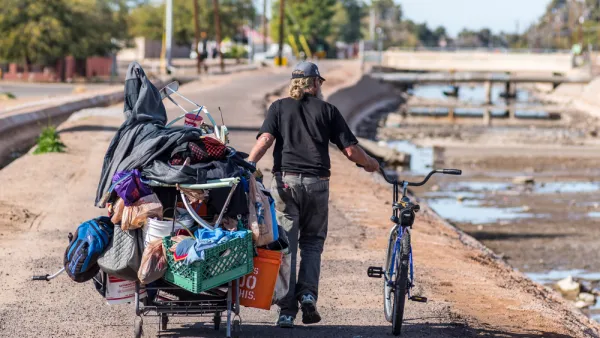
HUD Grants Total $315 Million for Continuum of Care for the Unhoused
An unprecedented federal grant program, announced earlier this month, will support continuum of care for the unhoused in unsheltered and rural settings.

Planetizen Federal Action Tracker
A weekly monitor of how Trump’s orders and actions are impacting planners and planning in America.

The state-sanctioned urbicide of Austin
People don’t kill cities. Freeways do.

US to reduce Colorado River water deliveries to Mexico
A new Colorado Treaty amendment reduces Mexico’s Colorado River water allocation by 250,000 acre feet.

5 New England states march closer to 800 megawatt wind energy project
Securing federal approval for the project may be complicated under the Trump administration, which has historically been hostile towards domestic wind power.

Baltimore to break ground on $50 million Transit Priority Project
The project will bring faster bus trips, safer streets and better bike connections to Baltimore.

Airbnb launches $250 million 'last-dollar financing' housing accelerator, makes first investment in Austin
The company will put $6.4 million towards affordable housing development in Texas’ capital.

FREE Course: Walkable City 1: Why Walkability?
After describing his path towards focusing on walkability as the essence of good planning, Jeff Speck marches through his five principal reasons for making more walkable places.
Reinventing Malls: Planning Alchemy—Turning Gray Fields Into Gold
The course focuses on the opportunities and imperatives that shape reinvention of mall sites.

Eagle County Government
Harvard University Graduate School of Design
Nashville Planning Department
The Architects Foundation
University of Cincinnati Online
The Pocatello Development Authority
The Urban Renewal Agency of the City of Pocatello
Journal of the American Planning Association