As subway riders return in fits and starts, some stations are experiencing a much faster recovery than others.


New York City's subway riders are coming back, but the return has been uneven across the city's boroughs. Michael Gold, Ana Ley and James Thomas explore the differences in ridership patterns in Manhattan, Brooklyn, and Queens.
Stations in lower-income areas in Brooklyn, Queens and Upper Manhattan, where residents are less likely to be able to work from home and typically depend more on public transit, have rebounded far faster than stations in office-heavy sections of Manhattan, including some that were once the busiest in the system, where many workers are still able to work remotely.
The system's low ridership numbers put it in the same difficult position as transit agencies around the country that are struggling to continue serving transit-dependent riders while dealing with labor shortages and slashed revenues.
The article details the experiences of riders at three different stations. The daily commute never stopped for many essential workers at the Junction Boulevard station in Queens, where ridership was back to 74.2 percent of pre-pandemic levels by November 2021. Meanwhile, ridership at Manhattan's Wall Street station, one of the system's lowest, remains at a dismal 37.5 percent of 2019 levels. The article notes that the drop in commuters has deeply affected the small businesses that depended on white-collar workers, while some riders avoid the eerily empty subway because of safety concerns, an issue the city is trying to mitigate with more visible patrols and PR campaigns.
FULL STORY: Here’s Where Subway Riders Have Returned. And Where They Haven’t.

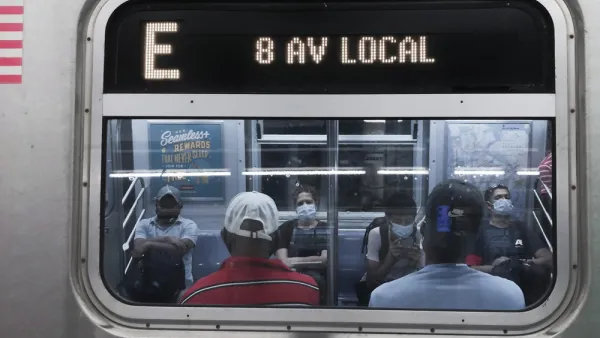
New York Subway Sets Pandemic Ridership Record
With school back in session and Broadway shows open to the public, subway ridership is surging in New York City, but still well below pre-pandemic levels.
New York Subway Surpasses 1 Billion Riders for the First Time Since 2019
There’s still a long way to go for the nation’s busiest transit system to get back to pre-pandemic ridership levels, but New Yorkers crossed at least one symbolic threshold in 2022.
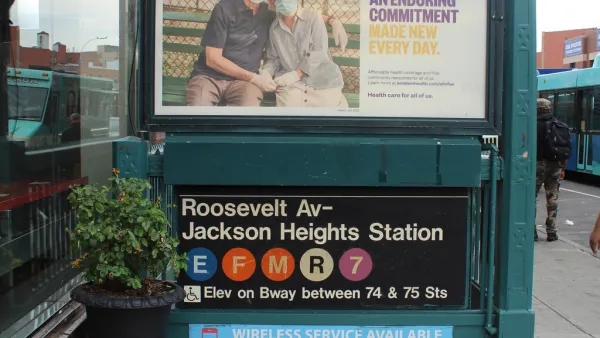
NYC Transit Ridership Patterns Have Shifted to the Outer Boroughs
Signs of the times, and more evidence of the essential service provided by public transit throughout the pandemic.

Planetizen Federal Action Tracker
A weekly monitor of how Trump’s orders and actions are impacting planners and planning in America.

The state-sanctioned urbicide of Austin
People don’t kill cities. Freeways do.

US to reduce Colorado River water deliveries to Mexico
A new Colorado Treaty amendment reduces Mexico’s Colorado River water allocation by 250,000 acre feet.

Mamdani overhauls NYC's Vision Zero plan with 100 new policy goals
The overhaul aims to reduce traffic deaths and make streets safer for pedestrians, cyclists and drivers through lower speed limits, new safety infrastructure and more.

Amtrak not solely to blame for New Jersey commuter rail's unreliability, report finds
A new study from the Garden State Initiative found that NJ Transit’s budget grew 20% across a 4 year period, but reliability declined significantly over the same period.

EPA erases limits on planet-warming pollution from power plants
Under Monday’s plan, power plants would still have some limits on how much mercury, arsenic and other contaminants they can emit.

FREE Course: Walkable City 1: Why Walkability?
After describing his path towards focusing on walkability as the essence of good planning, Jeff Speck marches through his five principal reasons for making more walkable places.
Reinventing Malls: Planning Alchemy—Turning Gray Fields Into Gold
The course focuses on the opportunities and imperatives that shape reinvention of mall sites.

Eagle County Government
Harvard University Graduate School of Design
Nashville Planning Department
The Architects Foundation
University of Cincinnati Online
The Pocatello Development Authority
The Urban Renewal Agency of the City of Pocatello
Journal of the American Planning Association