France passed a law that required cities to have a certain percentage of social housing. Since then the country's most exclusionary cities and suburbs have seen a fivefold increase in the availability of social housing.


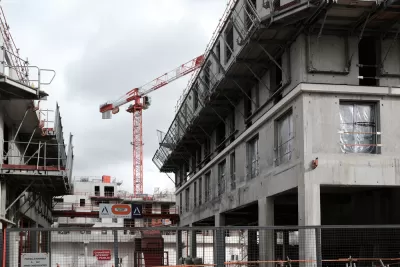
In December 2000, France adopted an ambitious new law meant to address the patterns of economic segregation that had left affordable housing concentrated heavily in lower-income, outlying suburban communities. Solidarité et Renouvellement Urbain, or Urban Solidarity and Renewal (SRU), mandated that French municipalities ensure that at least 20 percent of their total housing stock be “social housing,” subsidized affordable housing restricted to lower-income residents.
After more than a decade of weak compliance by cities, France revised the law in 2013 to increase the requirement to 25 percent social housing and increase the financial penalties for failing to comply. The amended law also included a threat: If communities didn’t start constructing social housing or converting existing buildings to social housing, the federal government would use eminent domain to do it for them.
More than two decades after the law’s passage, new research from the Lincoln Institute of Land Policy attempts to determine whether SRU has been effective in its aim to get every French city to do its fair share when it comes to providing affordable housing and how such a law could work in the U.S. Though many French cities have yet to meet the 25 percent social housing threshold, author Yonah Freemark, an Urban Institute senior research associate, says the law has been a success. For example, he found that France’s most exclusionary cities and suburbs have seen a fivefold increase in the availability of social housing since the law was passed. In the Paris metro region, the number of municipalities with less than 7 percent social housing was reduced from 86 cities to 45 as they increased their social housing stock.
Shelterforce spoke with Freemark to learn more about SRU, its efficacy and shortcomings, and the lessons the law holds for the United States and its own attempts and failings to address the concentration of poverty and expand affordable housing opportunities in exclusionary communities.
Josh Cohen: What is the SRU law trying to accomplish?
Yonah Freemark: The general goal of the SRU law as passed in 2000 was to combat the systemic problems of segregation and inequality that occur across French metropolitan regions. The idea was that by requiring a certain level of affordable housing in every community then the problems related to discrimination and segregation would be reduced. As initially passed in 2000, the law had some ambitious goals, but ...
Read the full story: Could France’s Approach to Combating NIMBYism Work in the United States?

Judge says Rhode Island town can't seize private lot to block affordable housing
The town of Johnston moved to seize a lot for municipal buildings after its owners submitted a plan for a 254-unit housing development.
The new Texas law declawing NIMBYs
State lawmakers gutted an old Jim Crow-era state law that required a city council supermajority to approve a new housing development if neighbors petitioned the proposal.

When can a power company take your land for data center infrastructure?
Meeting data center power demands will mean building more transmission lines and acquiring more land to put them on.

Planetizen Federal Action Tracker
A weekly monitor of how Trump’s orders and actions are impacting planners and planning in America.

The state-sanctioned urbicide of Austin
People don’t kill cities. Freeways do.

Colorado’s Largest Data Center Could Rise Next to Homes — Without a Public Hearing
The proposed campus would consume 11 times the power of Denver International Airport; as it has across the country, opposition mounts.

Nation's most wind-powered state turns to coal as data centers increase energy demand
For the first time in decades, Iowa has increased its generation of coal power.

NYC cools commuters with city's first rain garden above a bus stop
New York City officials say the plants in the rain garden can absorb 16 gallons of rainwater during heavy storms.

Brightline West’s future may rely on $6 billion federal loan
The company has until Nov. 2 to make a $400 million equity investment into its proposed high-speed rail line.

FREE Course: Walkable City 1: Why Walkability?
After describing his path towards focusing on walkability as the essence of good planning, Jeff Speck marches through his five principal reasons for making more walkable places.
Reinventing Malls: Planning Alchemy—Turning Gray Fields Into Gold
The course focuses on the opportunities and imperatives that shape reinvention of mall sites.

Greater Baltimore Committee
Eagle County Government
Harvard University Graduate School of Design
The Architects Foundation
University of Cincinnati Online
The Pocatello Development Authority
The Urban Renewal Agency of the City of Pocatello
Journal of the American Planning Association