The town of Johnston moved to seize a lot for municipal buildings after its owners submitted a plan for a 254-unit housing development.


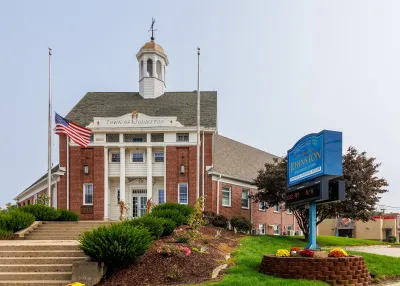
A federal court rejected Johnston, Rhode Island's attempt to use eminent domain to seize a privately owned lot, reports Christian Britschgi in Reason.
"The property in question is a 31-acre site owned by several members of the Santoro family, through their company SCLS Realty, LLC," Britschgi explains. The company proposed a 254-unit housing project on the site, which town officials vowed to oppose.
The Santoros relied on a new state law to build a project larger than typical zoning rules allow by including affordable units. In response, the town announced it would seize the property under eminent domain to build new municipal buildings.
According to Britschgi, "Yesterday's decision by the district court minced no words when declaring that the town's speedy seizure of the property was illegal, as it did not follow Rhode Island's much more detailed regulations governing eminent domain."
Read the full story: Federal Court Slaps Down Rhode Island Town's Surprise Seizure of Family's Land


The trouble with QUIMBY, revisited — a rebuttal to a rebuttal
In a perfect world, QUIMBY might get us a bit closer where we need to go. But, this YIMBY argues, not close enough.

Survey: 59% of LA Residents Want Dense Housing in Their own Neighborhoods
A UCLA survey reveals strong support for new apartments across the city, bucking the notion that Angelenos are NIMBYs.

The Trouble With QUIMBY
The idea of “quality urbanism in my back yard” has its uses, but should not be used to limit housing supply.

Planetizen Federal Action Tracker
A weekly monitor of how Trump’s orders and actions are impacting planners and planning in America.

California plans to bury El Niño’s downpour
If the state plays its cards right, it may be able to store a billion acre-feet of El Niño’s water in aquifers.

Chicago breaks ground on $3 billion megadevelopment
The new neighborhood, titled Foundry Park, will one day host 3,700 residences.

Want to study the Missouri River? Soon, you may need unanimous approval from 10 states
Legislation would require 10 governors’ permission to study or build projects moving water outside the basin.

Desperate measures: Advocates weigh draining Lake Powell to fill Colorado River
Draining the reservoir could reduce evaporation losses by a couple hundred thousand acre-feet.

This road in NYC is infamously dangerous — and Mamdani can't fix it
New York City's Ocean Parkway is known for reckless driving, but the power to implement safety measures lies with the state rather than the city.

FREE Course: Walkable City 1: Why Walkability?
After describing his path towards focusing on walkability as the essence of good planning, Jeff Speck marches through his five principal reasons for making more walkable places.
Reinventing Malls: Planning Alchemy—Turning Gray Fields Into Gold
The course focuses on the opportunities and imperatives that shape reinvention of mall sites.


City of Rosemead
Rutgers University, Edward J. Bloustein School of Planning and Public Policy
One Hundred Miles
Hunter College, City University of New York (CUNY)
The Architects Foundation
University of Cincinnati Online
City of Cambridge
Montrose County
The Pocatello Development Authority