The focus on gentrifying communities has, in many cases, eclipsed the similar problems facing more stagnant neighborhoods.


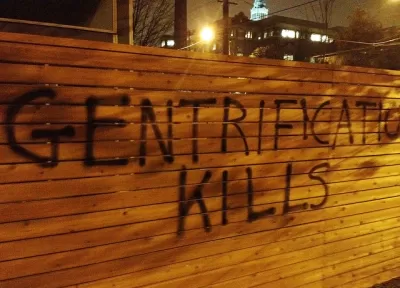
What is gentrification? Jerusalem Demsas attempts to define this slippery term, whose use has steadily grown since the 1990s, and assess what people really mean when they use it. Coined in 1964 by sociologist Ruth Glass "to describe the process of 'middle class liberal arts intelligentsia' moving into her primarily working-class London neighborhood," gentrification has, in the eyes of most Americans, come to signify the displacement and other negative impacts of redevelopment and neighborhood change. The Urban Displacement Project defines gentrification as "a process of neighborhood change that includes economic change in a historically disinvested neighborhood — by means of real estate investment and new higher-income residents moving in — as well as demographic change — not only in terms of income level, but also in terms of changes in the education level or racial make-up of residents." Planetizen defines gentrification similarly, as "a process of neighborhood change, usually resulting from an influx of relatively wealthy, white residents to a neighborhood."
But this focus, argues Demsas, obscures the fact that "the core rot in American cities is not the gentrifying neighborhoods: It is exclusion, segregation, and concentrated poverty." As activists focus on the changes happening in working-class neighborhoods, "[w]hite, wealthy neighborhoods that have refused class and racial integration have successfully avoided much scrutiny," says Demsas. "While stagnant, segregated neighborhoods are an accepted backdrop of American life, fast-changing, diverse neighborhoods and the culture clash that accompanies gentrification are the battlefield where all the disagreements come to the forefront."
All of the problems people worry about when they invoke gentrification — displacement, police action against people of color, lack of investment, predatory landlords — are also present in segregated neighborhoods, often even more so.
Demsas concludes, "it becomes clear why we focus on gentrification while the unseen culprits (segregated enclaves) are able to avoid controversy: Gentrification is the most visual manifestation of inequality in urban life." But displacement and disinvestment harm non-gentrifying communities at similar–or even higher–rates, suggesting a need to broaden the lens through which activists and policymakers view urban poverty.
FULL STORY: What we talk about when we talk about gentrification


Revitalization Should Not Overshadow the Continued Decline in Cities
When gentrification takes center stage, neglected places facing poverty, segregation, and disinvestment are overlooked.
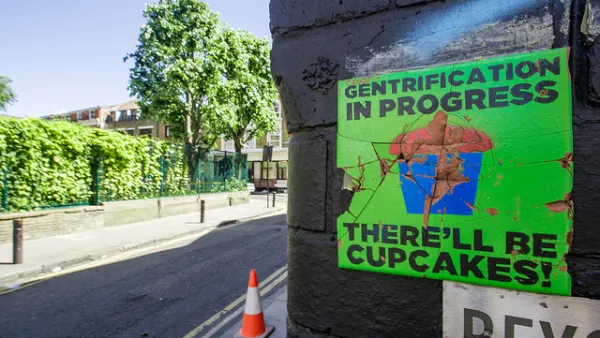
Who’s Afraid of Gentrification?
Examining the complex sources of concerns about displacement and opposition to investment in low-income neighborhoods.
Census Data: Black Americans Leaving Cities for Suburbs
The trend of Black Americans leaving urban areas for suburban communities mirrors the White Flight of the mid-20th century but for vastly different reasons and with vastly different consequences.

The state-sanctioned urbicide of Austin
People don’t kill cities. Freeways do.

US to reduce Colorado River water deliveries to Mexico
A new Colorado Treaty amendment reduces Mexico’s Colorado River water allocation by 250,000 acre feet.

New Jersey’s second-largest city bans standalone data centers
Jersey City will continue to allow co-location facilities, such as those meant for research institutions that store their own data.

Amtrak not solely to blame for New Jersey commuter rail's unreliability, report finds
A new study from the Garden State Initiative found that NJ Transit’s budget grew 20% across a 4 year period, but reliability declined significantly over the same period.

EPA erases limits on planet-warming pollution from power plants
Under Monday’s plan, power plants would still have some limits on how much mercury, arsenic and other contaminants they can emit.

Phoenix announces new on-demand transit service, more frequent RAPID buses
Both new services will launch in October, and are part of Phoenix's Project Effective Access Solutions for Easing Congestion.

FREE Course: Walkable City 1: Why Walkability?
After describing his path towards focusing on walkability as the essence of good planning, Jeff Speck marches through his five principal reasons for making more walkable places.
Reinventing Malls: Planning Alchemy—Turning Gray Fields Into Gold
The course focuses on the opportunities and imperatives that shape reinvention of mall sites.

Eagle County Government
Harvard University Graduate School of Design
Nashville Planning Department
The Architects Foundation
University of Cincinnati Online
The Pocatello Development Authority
The Urban Renewal Agency of the City of Pocatello
Journal of the American Planning Association