The U.S. Soccer Foundation and Target are partnering with schools, cities, and counties nationwide to create safe places for kids to play soccer and improve communities.


Have you heard of a "mini-pitch"? Essentially, it is a small, customized, hard court that is created for organized soccer programs and pick-up games. As reported by the Antelope Valley Press, the U.S. Soccer Foundation and Target created a new mini-pitch at El Dorado Park in the city of Lancaster in northern Los Angeles County earlier this year. This project is part of the U.S. Soccer Foundation’s Safe Places To Play program which seeks to transform underutilized areas into state-of-the-art pitches and create safe soccer play spaces that all community residents can use.
Target pledged $6 million to create 100 mini-pitches in communities across the country by the end of 2020, with Lancaster selected as one of the recipients. Target and the U.S. Soccer Foundation have set an even more ambitious goal of installing 1,000 mini-pitches by 2026.
Each mini-pitch installation typically includes:
- A brightly colored court that transforms the look and feel of the location where it is built, whether it be a park or a school.
- Lighting which extends the number of hours kids and adults can play in a day.
- ADA-accessible gates and hard-court surface which allows for everyone to be able to play on the pitch.
- Lockable storage, benches, and other enhancements which provide convenience to players and spectators.
According to the U.S. Soccer Foundation, mini-pitches have positively impacted communities. Surveys conducted after installation of mini-pitches indicate that:
- 98% say that people in the community are more active.
- 98% say that the community feels safer.
- 93% say that mini-pitches serve as community gathering places.
To find a mini-pitch near you, check out this locator tool.
Read the full story: New soccer pitch is complete at Lancaster’s El Dorado Park
Improving Communities Through Soccer
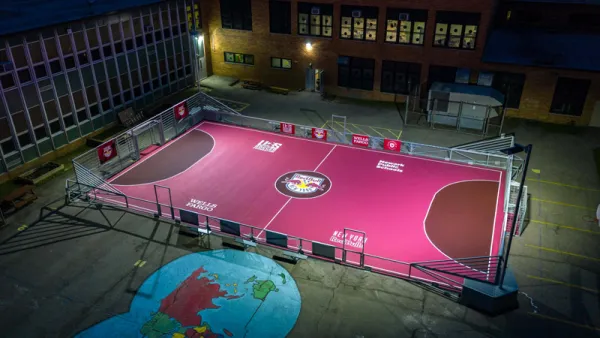
LEGO has partnered with the U.S. Soccer Foundation to create a new safe place for kids to play soccer and gain life skills in Albuquerque, New Mexico.

Planetizen Federal Action Tracker
A weekly monitor of how Trump’s orders and actions are impacting planners and planning in America.

California plans to bury El Niño’s downpour
If the state plays its cards right, it may be able to store a billion acre-feet of El Niño’s water in aquifers.

Desperate measures: Advocates weigh draining Lake Powell to fill Colorado River
Draining the reservoir could reduce evaporation losses by a couple hundred thousand acre-feet.

Mamdani’s pied-à-terre tax survives legal challenge
A panel of judges found that the plaintiffs failed to demonstrate injury as a result of New York City's implementation of the tax.

Eastern Nebraska is running out of electricity
Data centers and electrification are straining eastern Nebraska’s grid, throttling economic development.

Seattle passes record-breaking transit services expansion
Proposition 1 will double the city’s transit tax to add 95,000 more bus trips and preserve 180,000 bus trips annually.

FREE Course: Walkable City 1: Why Walkability?
After describing his path towards focusing on walkability as the essence of good planning, Jeff Speck marches through his five principal reasons for making more walkable places.
Reinventing Malls: Planning Alchemy—Turning Gray Fields Into Gold
The course focuses on the opportunities and imperatives that shape reinvention of mall sites.

City of Rosemead
Rutgers University, Edward J. Bloustein School of Planning and Public Policy
One Hundred Miles
University of Michigan School for Environment and Sustainability (SEAS)
Hunter College, City University of New York (CUNY)
The Architects Foundation
City of Cambridge
Montrose County
The Pocatello Development Authority