Pitting the straw men of scale and community control against one another does the field more harm than good.


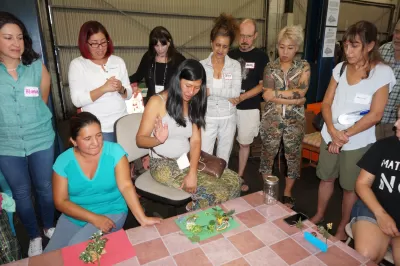
"This is no longer my neighborhood.”
Too often, communities of color that experience new investments report that the changes are detrimental to their lives and a benefit to newcomers, who tend to be more affluent and often predominantly white households. Residents of color can experience social and cultural alienation and a loss of political influence.
The community land trust (CLT) model attempts to address both the perception and the reality of these shifts in power and culture by placing the residents of homes located on the CLT’s land in key leadership and decision-making positions and by putting the needs of low-income residents at the center of the CLT’s mission. Importantly, most CLTs are membership based, with the membership electing the board and having direct say over land disposition.
A major debate among CLT practitioners and advocates involves the tradeoffs and tensions between "going to scale" with the housing portfolio and enacting "community control." People on one side of this debate make the case that increasing the number of homes held in trust is necessary, both for the financial sustainability of CLTs and for the production and preservation of mixed-income communities. The other side argues that ever-increasing scale may inevitably erode the community’s and local residents’ control in decision making—a vital part of the CLT governance model.
Making straw men of scale and community control and pitting them against each other does the field more harm than good. Instead, we at Grounded Solutions support reconciling and balancing the two goals to create more comprehensive CLT-based approaches that advance racial justice and inclusive community development.
Meet the Straw Men
In the debate over whether CLT practitioners and advocates should focus on community control or scale, one side says that getting too big in certain ways, especially expanding across geographies bigger than a couple of neighborhoods, is antithetical to community control. Grassroots groups taking this position tend to minimize efforts to build the resource systems and infrastructure that CLTs need to develop and grow their impact (e.g., enabling public policies, a pipeline of real estate assets, and financing) because these activities are perceived as removed from the communities the groups are trying to serve.
On the other hand groups that focus solely on scale tend to minimize community organizing and planning, resident empowerment, community ownership, and authentic place-based leadership of the CLT, often claiming that the time and processes needed to cultivate real community control are a barrier to achieving scale.
FULL STORY: Community Land Trusts: Combining Scale and Community Control


Five Ways to Break the Cycle of Extractive Real Estate
Here are the steps to having economies operated by stewardship, not speculation.

Land Trusts Put Commercial Real Estate in Community Hands
A growing movement to create community-owned commercial spaces could shift power away from institutional landlords.

The Power of Community Land Trusts
A New York Times article explains and, potentially, introduces the community land trust concept, which has proven immensely capable of preventing displacement and foreclosures while advancing homeownership and racial equity.

Planetizen Federal Action Tracker
A weekly monitor of how Trump’s orders and actions are impacting planners and planning in America.

The state-sanctioned urbicide of Austin
People don’t kill cities. Freeways do.

US to reduce Colorado River water deliveries to Mexico
A new Colorado Treaty amendment reduces Mexico’s Colorado River water allocation by 250,000 acre feet.

Mamdani overhauls NYC's Vision Zero plan with 100 new policy goals
The overhaul aims to reduce traffic deaths and make streets safer for pedestrians, cyclists and drivers through lower speed limits, new safety infrastructure and more.

Amtrak not solely to blame for New Jersey commuter rail's unreliability, report finds
A new study from the Garden State Initiative found that NJ Transit’s budget grew 20% across a 4 year period, but reliability declined significantly over the same period.

EPA erases limits on planet-warming pollution from power plants
Under Monday’s plan, power plants would still have some limits on how much mercury, arsenic and other contaminants they can emit.

FREE Course: Walkable City 1: Why Walkability?
After describing his path towards focusing on walkability as the essence of good planning, Jeff Speck marches through his five principal reasons for making more walkable places.
Reinventing Malls: Planning Alchemy—Turning Gray Fields Into Gold
The course focuses on the opportunities and imperatives that shape reinvention of mall sites.

Eagle County Government
Harvard University Graduate School of Design
Nashville Planning Department
The Architects Foundation
University of Cincinnati Online
The Pocatello Development Authority
The Urban Renewal Agency of the City of Pocatello
Journal of the American Planning Association