Here are the steps to having economies operated by stewardship, not speculation.


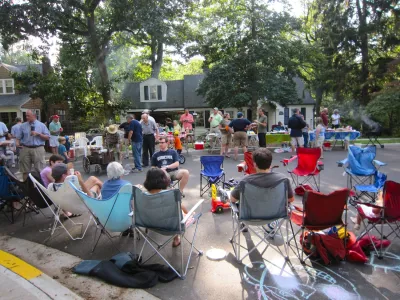
In communities across the U.S., residents are rewriting the rules of real estate ownership—moving from isolated projects to coordinated ecosystems that center stewardship over speculation.
This article traces how community-led ownership evolves across five stages: from single transformative projects to a full-fledged field that shapes national policy.
Examples include:
-
East Phillips Neighborhood Institute (Minneapolis) – Building a community-owned resilience hub that transforms an environmentally contaminated site into a neighborhood-powered source of food, clean energy, and jobs.
-
Kensington Corridor Trust (Philadelphia) – Using a perpetual purpose trust to de-speculate a commercial corridor and return control of over 30 properties to local stakeholders.
-
SHARE Baltimore – Coordinating land trusts, financing, and advocacy into a predictable pipeline for permanently affordable housing.
-
Chicago’s Community WEB – Aligning city government, funders, and grassroots organizers to build shared infrastructure for worker co-ops, CLTs, and community investment funds.
The author identifies five shifts needed to make community ownership mainstream: redefining ownership as stewardship; aligning public power with community goals; structuring capital around people, not portfolios; funding long-haul ecosystem infrastructure; and measuring success by belonging and stability—not just units or ROI.
Together, these examples show how community ownership can evolve from pilots to pipelines to policy—transforming not only who owns property, but how wealth, stability, and decision-making power are shared.
Read the full story: What Would It Take to Make Community Ownership the Rule, Not the Exception?


Report Links Zoning and Land Use to Structural Racism
The historically comprehensive study outlines the policies that have shaped homeownership, generational wealth, and economic development in the Puget Sound region.

Oregon cities are excluding a key tool that could help their housing goals: maps
An effort to use geospatial analysis to understand how housing and access to opportunity are distributed in Oregon cities has largely stalled.

Wisconsin's declining population reduces housing needs by almost 50%
The state's working age population declined by over 25,000 people between 2020 and 2024.

Planetizen Federal Action Tracker
A weekly monitor of how Trump’s orders and actions are impacting planners and planning in America.

California plans to bury El Niño’s downpour
If the state plays its cards right, it may be able to store a billion acre-feet of El Niño’s water in aquifers.

Chicago breaks ground on $3 billion megadevelopment
The new neighborhood, titled Foundry Park, will one day host 3,700 residences.

California High-Speed Rail Authority CEO resigns after $600,000 scandal
Under Ian Choudri, the authority used taxpayer dollars to fund first class flights and trips to nightclubs.

Want to study the Missouri River? Soon, you may need unanimous approval from 10 states
Legislation would require 10 governors’ permission to study or build projects moving water outside the basin.

Desperate measures: Advocates weigh draining Lake Powell to fill Colorado River
Draining the reservoir could reduce evaporation losses by a couple hundred thousand acre-feet.

FREE Course: Walkable City 1: Why Walkability?
After describing his path towards focusing on walkability as the essence of good planning, Jeff Speck marches through his five principal reasons for making more walkable places.
Reinventing Malls: Planning Alchemy—Turning Gray Fields Into Gold
The course focuses on the opportunities and imperatives that shape reinvention of mall sites.

City of Rosemead
Rutgers University, Edward J. Bloustein School of Planning and Public Policy
One Hundred Miles
Hunter College, City University of New York (CUNY)
The Architects Foundation
University of Cincinnati Online
City of Cambridge
Montrose County
The Pocatello Development Authority