A novel approach to quantifying the world's urban population provides insight into a changing world.


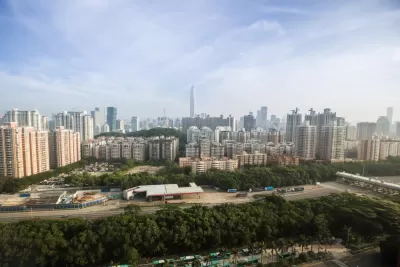
The European Commission and the Organization for Economic Cooperation and Development (OECD) recently presented "groundbreaking new mapping research" at World Urban Forum 10, concluding that there are around 10,000 cities in the world.
Gregory Scruggs shares insight into the unprecedented effort to document and define the contemporary city in an article for Next City. Nailing down a definition of cities is surprisingly challenging. Nuances can neglect huge swaths of the built environment or in wildly different population estimates.
No two countries define cities the same way, notes Scruggs: "In Denmark, 200 people living near each other constitutes a city. In Japan, the threshold is 50,000," for example.
The new mapping project overcomes some of those challenges by adding a third definition besides urban and rural: the town. According to Scruggs's explanation of the new definition, "over a quarter of the planet lives in towns — like those Danish hamlets of 200-odd souls — a category that the world has largely ignored in its preference for an urban-rural binary, the idea that someone either lives in a city or in the countryside."
A few findings from the study stand out: half of the world's 10,000 cities didn't exist 40 years ago, for example, and 20 percent of the world's cities are shrinking. "[Shrinking is] getting more common in countries where the population has started to stagnate or decline," according to a quote from OECD’s head of urban statistics, Rudiger Ahrend, included in the article.
Read the full story: There are 10,000 Cities on Planet Earth. Half Didn’t Exist 40 Years Ago

Is the Urban Form Sustainable?
One author offers a framework for resilience that rethinks common assumptions about the inevitability of cities as we know them.
The Fastest Growing Cities in the World
None of the fastest growing cities in the world are found in North or South America.

The 2010s Didn't Live Up to Potential as the 'Decade of the City'
The renaissance predicted for urban areas in the United States started strong during the 2010s but slowed in the years leading up to a potentially generation defining pandemic.

Planetizen Federal Action Tracker
A weekly monitor of how Trump’s orders and actions are impacting planners and planning in America.

Chicago breaks ground on $3 billion megadevelopment
The new neighborhood, titled Foundry Park, will one day host 3,700 residences.

This MA town is drowning in its own sewage — and residents like it that way
Susan Murcott, a waste water expert, said if Carlisle didn't address their leaking sewage, the problem could turn “deadly.”

With no reauthorization bill in sight, Texas slashes $6.6 billion from transportation budget
An official said the program may receive additional funding when a federal reauthorization bill passes.

Chicago’s new transit authority has ‘unprecedented’ land development power
The Northern Illinois Transit Authority is allowed to buy and develop land for reasons unrelated to transit, a power that is fairly unique among transit authorities.

Iowa taxpayers are paying thousands to clean manure out of their water
While the Clean Water Act makes states responsible for regulating factory farms that discharge pollutants, Iowa has turned a blind eye to the polluting farms.

FREE Course: Walkable City 1: Why Walkability?
After describing his path towards focusing on walkability as the essence of good planning, Jeff Speck marches through his five principal reasons for making more walkable places.
Reinventing Malls: Planning Alchemy—Turning Gray Fields Into Gold
The course focuses on the opportunities and imperatives that shape reinvention of mall sites.

City of Rosemead
Rutgers University, Edward J. Bloustein School of Planning and Public Policy
One Hundred Miles
The Architects Foundation
University of Cincinnati Online
Montrose County
The Pocatello Development Authority
The Urban Renewal Agency of the City of Pocatello