As Americans deal with job losses and ongoing unemployment, rent bills are piling up and a wave of evictions looms on the horizon.


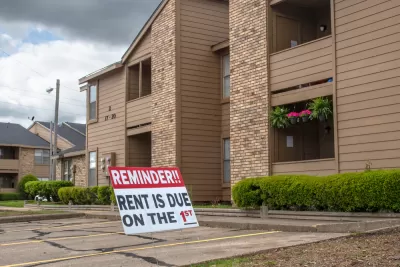
Americans are falling behind economically, according to a pair of studies released at the end of September, and the bills are piling up.
“Renter households across the U.S. are on track to owe as much as $34 billion in past-due rent by January and up to 8.4 million of those households could be hit with an eviction filing by that time,” reports Bill Lucia.
The information comes from a new report published by the National Council of State Housing Agencies last week. The report was prepared by the advisory firm Stout, Risius Ross LLC.
Using data from the U.S. Census Bureau, “the analysis concluded that, based on survey data from mid-September, between 9.7 million and 14.2 million renter households, or 23 million to 34 million individual renters, were falling behind on rent,” explains Lucia.
“The report estimates that the rent shortfall in September for these renters was in the $12 billion to $16 billion range, and that it rises to $25 billion to $34 billion by January.”
Another study, published by the Pew Research Center at the end of September, found that one-in-four Americans are having trouble paying the bills during the pandemic, with lower-income Americans are more likely to have trouble paying bills during the pandemic. The report also finds higher likelihoods of job losses among young Americans and low-income Americans.
Read the full story: Overdue Rent is Piling Up and Could Total $34 Billion by January, Estimates Show

CDC's Eviction Moratorium Extended
The CDC's eviction moratorium will stay in place until at least June 30, 2021.
Emergency Rental Relief Gaining Momentum in Some States
Rental assistance spending in June surpassed the entire year's total so far, but there's still a long way to go.

Haves and Have Nots: Planning and the Deep Divides of the Pandemic
The latest in a series of compendia gathering news and analysis about the effects of the COVID-19 on the built and natural environments—now and long into the future.

Planetizen Federal Action Tracker
A weekly monitor of how Trump’s orders and actions are impacting planners and planning in America.

The state-sanctioned urbicide of Austin
People don’t kill cities. Freeways do.

US to reduce Colorado River water deliveries to Mexico
A new Colorado Treaty amendment reduces Mexico’s Colorado River water allocation by 250,000 acre feet.

Nation's most wind-powered state turns to coal as data centers increase energy demand
For the first time in decades, Iowa has increased its generation of coal power.

NYC cools commuters with city's first rain garden above a bus stop
New York City officials say the plants in the rain garden can absorb 16 gallons of rainwater during heavy storms.

Brightline West’s future may rely on $6 billion federal loan
The company has until Nov. 2 to make a $400 million equity investment into its proposed high-speed rail line.

FREE Course: Walkable City 1: Why Walkability?
After describing his path towards focusing on walkability as the essence of good planning, Jeff Speck marches through his five principal reasons for making more walkable places.
Reinventing Malls: Planning Alchemy—Turning Gray Fields Into Gold
The course focuses on the opportunities and imperatives that shape reinvention of mall sites.

Eagle County Government
Harvard University Graduate School of Design
Nashville Planning Department
The Architects Foundation
University of Cincinnati Online
The Pocatello Development Authority
The Urban Renewal Agency of the City of Pocatello
Journal of the American Planning Association