Los Angeles organizers work with park professionals on policies to allow green space investment in neighborhoods that have lacked it without paving the way for displacement.


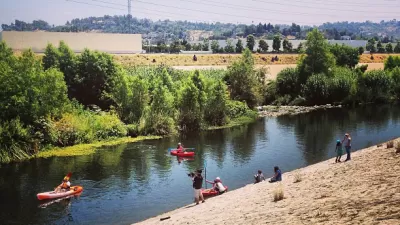
Parks are the backbone of a healthy neighborhood. They’re a space where people can gather, children can connect with and learn about nature, and families can engage in free, health-promoting activities.
But parks have also been historically used as tools for exclusion and racial segregation. The U.S. National Parks System was created specifically to steal land from Indigenous tribes. Seneca Village, one of the few neighborhoods in New York City where Black residents could own property (and therefore be eligible to vote), was demolished to make way for Central Park.
Despite their bucolic image, parks remain contested spaces, and tense encounters about who belongs in them often fall along racial and class lines, sometimes with tragic results. In 2014, Cleveland police shot and killed Tamir Rice, a 12-year-old Black boy who was playing in a park with a toy gun. More recently in New York City, a white woman named Amy Cooper feigned fear and threatened Christian Cooper, a Black bird-watcher who is not related to Amy Cooper, with police intervention after he asked her to leash her dog, per the rules of the park.
For low-income residents in Los Angeles, parks have become racialized symbols of “green gentrification” and displacement, where private yoga classes for wealthy white women are encouraged to take up public space while low-income primarily Latinx park vendors are ticketed and harassed. Green gentrification is a process in which cleaning up pollution or providing green amenities increases local property values and attracts wealthier residents to a previously polluted or disenfranchised neighborhood. This leads to landowners raising rents on the existing residents and businesses, eventually displacing them. Additionally, when higher-income folks move into an area, they often attempt to police the existing low-income residents engaging in activities like food vending or barbecues that—while legal and innocuous—are seen as unacceptable to the newer, wealthier residents.
But what if public parks could instead be reimagined as spaces that welcomed everyone and provided solutions to a broad range of community needs? That’s the vision behind ...
Read the full story: Keeping Gentrification From Following Green Space


The Need for an Equitable L.A. River Revitalization
Jon Christensen urges Los Angeles to ensure that new park amenities serve, rather than displace, the river's low-income communities.
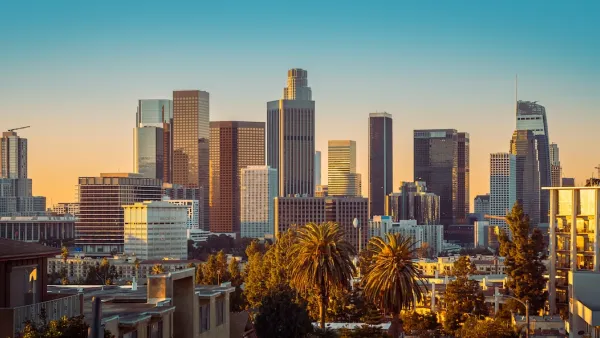
Empower LA: The LA2050 Grants Challenge
The 2025 LA2050 Grants Challenge invites organizations to become outreach partners and help mobilize Angelenos to vote on how $1 million in grants will be allocated to address key local issues like homelessness, income inequality, and park access.
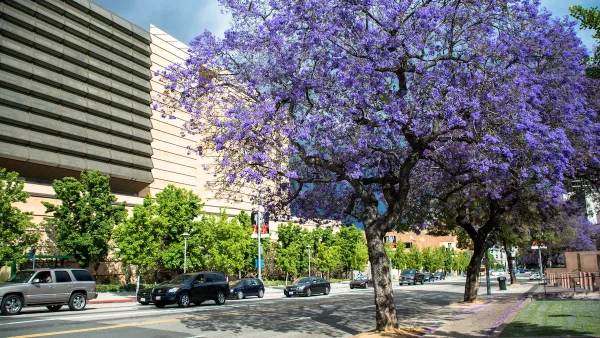
Addressing Tree Canopy Disparity in South Los Angeles
A new study highlights the complex challenge of addressing tree canopy disparities in South L.A., where historical environmental injustices, budget constraints, and competing community priorities hinder efforts to increase equitable tree coverage.

Planetizen Federal Action Tracker
A weekly monitor of how Trump’s orders and actions are impacting planners and planning in America.

The state-sanctioned urbicide of Austin
People don’t kill cities. Freeways do.

US to reduce Colorado River water deliveries to Mexico
A new Colorado Treaty amendment reduces Mexico’s Colorado River water allocation by 250,000 acre feet.

Nation's most wind-powered state turns to coal as data centers increase energy demand
For the first time in decades, Iowa has increased its generation of coal power.

NYC cools commuters with city's first rain garden above a bus stop
New York City officials say the plants in the rain garden can absorb 16 gallons of rainwater during heavy storms.

Brightline West’s future may rely on $6 billion federal loan
The company has until Nov. 2 to make a $400 million equity investment into its proposed high-speed rail line.

FREE Course: Walkable City 1: Why Walkability?
After describing his path towards focusing on walkability as the essence of good planning, Jeff Speck marches through his five principal reasons for making more walkable places.
Reinventing Malls: Planning Alchemy—Turning Gray Fields Into Gold
The course focuses on the opportunities and imperatives that shape reinvention of mall sites.

Greater Baltimore Committee
Eagle County Government
Harvard University Graduate School of Design
The Architects Foundation
University of Cincinnati Online
The Pocatello Development Authority
The Urban Renewal Agency of the City of Pocatello
Journal of the American Planning Association