The Providence Climate Justice Plan offers an exemplary approach to prioritizing the communities and neighborhoods most impacted by the environmental effects of development and industrial pollution.


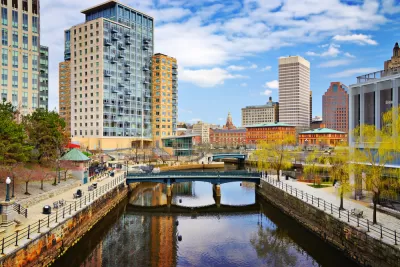
Like many cities, Providence has a long history of racial injustice with an environmental dimension. South Providence, Washington Park, Wanskuck, and the West End communities that border industrial areas have multiple sources of pollution and the highest levels of poverty, asthma, and lead poisoning in the state.
Unlike many cities, Providence has put these frontline communities at the forefront of its climate action. It is the only city in the country with a Climate Justice Plan. The process has been exemplary. The jury is out on what changes it will produce in practice.
I recently talked with the city’s director or sustainability, Leah Bamberger, to find out how the Climate Justice Plan came about. The process started when Bamberger was recruited from Boston to lead the Providence Office of Sustainability in 2015. When community organizers immediately started pushing her to focus on the needs of their neighborhoods, Bamberger was onboard. With grants from The Funders Network, an organization of private foundations that invests in building local capacity to create equitable and sustainable communities in the U.S. and Canada, and the Rhode Island Foundation, her team partnered with the Environmental Justice League and Groundwork Rhode Island, and with One Square World facilitating, a new kind of planning process began.
The Office of Sustainability was an equal among partners in the planning process. In addition to five members representing city departments, representatives from the community were part of a Racial and Environmental Justice Committee that would explore ways to integrate racial equity into the city’s sustainability and resilience planning. After committee members, and city officials—including Mayor Jorge Elorza—participated in Undoing Racism trainings, the planning process began. Community representatives committed to about ten hours of meetings per month, for which they received a $1,300 honorarium.
The committee’s Equity in Sustainability report was released in June 2016. It listed 12 priorities identified by residents of frontline communities, including clean streets, industrial hazards, safety, public transit, and gentrification. A second year of funding allowed the committee to develop a framework for an updated plan that would establish equity goals, action items, and systemic evaluation of these goals. Bamberger explains, “Our intent was to shift the decision-making power to frontline communities, whose residents really led the development of this work.”
In October 2019, with the Just Providence Framework as its guidance, the city and committee released the Providence Climate Justice Plan. It outlines a strategy for achieving Mayor Jorge Elorza’s 2016 executive order calling for Providence to become a carbon-neutral city by 2050 while prioritizing the needs of frontline communities.
So the question is whether putting frontline communities first is aligned with the aggressive measures needed to achieve carbon neutrality. It’s easier said than done. Bamberger offers the example of increasing solar adoption. “The theory of change for many climate plans is to design policies and programs that capture the most people to reach the goals. This typically means starting with people who can afford solar, electric vehicles, or heat pumps first, leaving behind those who are most impacted by the climate crisis—low income communities of color. We start with the challenge of addressing the needs of these frontline communities first—working towards affordable, clean energy, and mitigating pollution in their neighborhoods, for example. We assume that markets will take care of wealthier residents.”
Will all this city-blessed community involvement lead to real change? One challenge is funding. One of the first elements of the plan to be implemented is the creation of two green justice zones for priority action, Olneyville and South Providence. Among the potential projects in the zones are building microgrids in key facilities to maintain power when outages occur, weatherization, renewable energy development, job training, and zoning reform to prevent polluting land uses, But to date, only $1 million of the city’s $222 million capital improvement plan, passed in January 2020, has been earmarked to support the zones. And with city and state budgets in crisis, it isn’t clear whether there will be additional funding.
Utility interests aren’t on board with the environmental justice goals and it appears that Governor Gina Raimondo isn’t either. In October 2018, regulators approved a controversial $180 million National Grid liquefied natural gas (LNG) facility on the industrial waterfront that is adding to the pollution mentioned above. Opponents pointed out that it would increase the state’s dependence on dirty shale gas obtained by hydraulic fracturing and lock in carbon emissions for the life of the facility. The Rhode Island Department of Health and several environmental and community organizations criticized the proposal as well. Governor Raimundo fought having their environmental justice concerns included in the proposal that went to the Federal Energy Regulatory Commission for approval. And despite his embrace of climate justice as a general principle and his adamant opposition of the new LNG facility, even Mayor Elorza supports the polluting energy infrastructure of the industrial waterfront as a needed economic development driver.
So while Providence is exemplary in bringing neighborhood groups and environmental justice goals into the planning process, the usual obstacles to real progress remain: inadequate funding, powerful interest groups, and contradictory goals. The Climate Justice Plan is a start in that it gives frontline communities a formal planning role and a bigger megaphone—which they will surely need.
As Scott Campbell pointed out in his classic 1996 article on the contradictions of sustainable development in the Journal of the American Planning Association, city (and state) officials will almost always choose economic concerns over environmental ones. That is the challenge of climate justice planning.

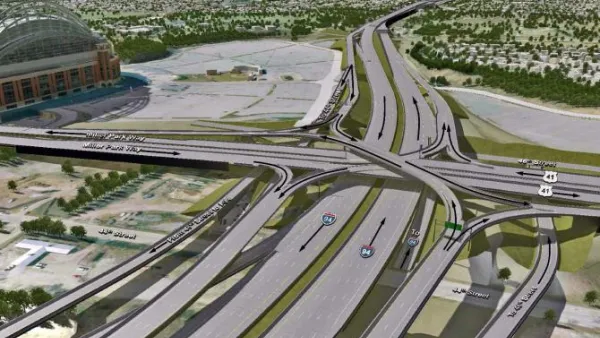
Opinion: Proposed I-94 Expansion a 'Fiasco' for Milwaukee
An opinion piece published by Urban Milwaukee argues against a proposed expansion of three miles of Interstate 94 in Milwaukee.
Vancouver's State-of-Art Climate Action Plan Incorporates Multiple Goals
The city of Vancouver's new Climate Emergency Action Plan incorporates a comprehensive scope of goals, including affordability, public health, and social equity, which can help build broad public support.
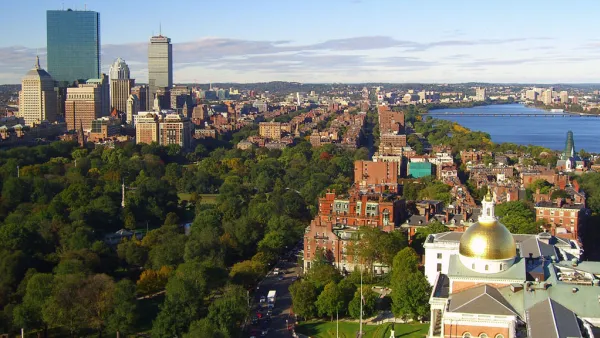
Boston Launches a 20-Year Urban Forestry Plan
The forthcoming Boston Urban Forestry Plan is expected to support communities that have been disproportionately exposed to environmental stressors.

Planetizen Federal Action Tracker
A weekly monitor of how Trump’s orders and actions are impacting planners and planning in America.

The state-sanctioned urbicide of Austin
People don’t kill cities. Freeways do.

US to reduce Colorado River water deliveries to Mexico
A new Colorado Treaty amendment reduces Mexico’s Colorado River water allocation by 250,000 acre feet.

Mamdani overhauls NYC's Vision Zero plan with 100 new policy goals
The overhaul aims to reduce traffic deaths and make streets safer for pedestrians, cyclists and drivers through lower speed limits, new safety infrastructure and more.

Amtrak not solely to blame for New Jersey commuter rail's unreliability, report finds
A new study from the Garden State Initiative found that NJ Transit’s budget grew 20% across a 4 year period, but reliability declined significantly over the same period.

EPA erases limits on planet-warming pollution from power plants
Under Monday’s plan, power plants would still have some limits on how much mercury, arsenic and other contaminants they can emit.

FREE Course: Walkable City 1: Why Walkability?
After describing his path towards focusing on walkability as the essence of good planning, Jeff Speck marches through his five principal reasons for making more walkable places.
Reinventing Malls: Planning Alchemy—Turning Gray Fields Into Gold
The course focuses on the opportunities and imperatives that shape reinvention of mall sites.

Eagle County Government
Harvard University Graduate School of Design
Nashville Planning Department
The Architects Foundation
University of Cincinnati Online
The Pocatello Development Authority
The Urban Renewal Agency of the City of Pocatello
Journal of the American Planning Association

