POLITICO Magazine surveyed designers, architects, planners, doctors, psychologists, logisticians, and others, asking them how they would redesign the world for the Covid-19 era and beyond.


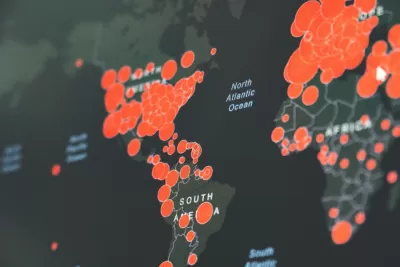
A variety of experts share how they would redesign our physical spaces and re-envision our models of service delivery. Some imagined ways to make physical spaces such as airports, apartments, offices, and parks more spacious and less risky to our health and wellbeing. Some envisioned new and more efficient models for delivering services as such as health care, medical supplies, social services, and voting. And others dreamed up ideas to sustain meaningful human interactions across physical and social distance. Here are the 19 ideas discussed in the article:
- Build skyward.
- Rethink restaurants - from back to front.
- Create more private outdoor spaces.
- Let airports sprawl.
- Replace prisons.
- Bring parks to people.
- Let the military manage the supply chain.
- Modernize the doctor house call.
- Create a new "healthist" economy.
- Refashion end-of-life care.
- Reimagine the retail experience.
- Replace short flights with buses.
- Sell diners on higher prices.
- Equip offices for the next crisis.
- Don't ditch in-person voting. Make it safer.
- Speed up delivery of government benefits.
- Keep distance learning in place.
- Enlist off-campus students in the recovery.
- Learn new communication tricks.
Read the full story: How to redesign the world for coronavirus and beyond
How Local Planners Can Lead a Proactive, Aggressive Response to the Pandemic
The novel coronavirus has so far preyed on the most vulnerable in cities, as a result of the planning failures of the previous century. Planners today can take steps to reverse that reality, if they reclaim their historic role.
Zoning Code Reform for the Realities of COVID-19
Local governments have more tools than money to relieve some of the economic experience experienced by residents and businesses as the economic effects of the novel coronavirus linger just as long as the public health crisis it causes.
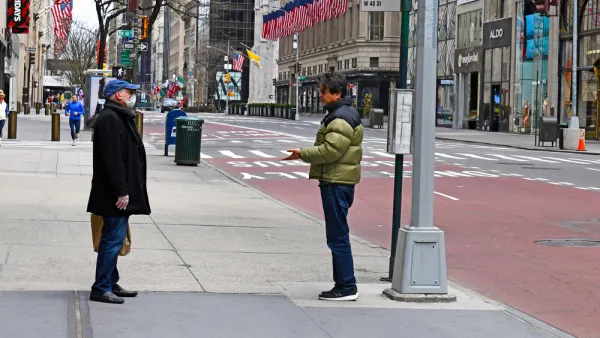
Friday Eye Candy: Covid-19, Then and Now
The New York Times compared images from readers portraying similar scenes in 2020 and 2022.

Planetizen Federal Action Tracker
A weekly monitor of how Trump’s orders and actions are impacting planners and planning in America.

California plans to bury El Niño’s downpour
If the state plays its cards right, it may be able to store a billion acre-feet of El Niño’s water in aquifers.

Desperate measures: Advocates weigh draining Lake Powell to fill Colorado River
Draining the reservoir could reduce evaporation losses by a couple hundred thousand acre-feet.

In Texas, data centers are swallowing promised parkland
Residents who moved to Taylor, Texas for a rural community now have to contend with three data centers in their backyard.

How a Chicago-sized wind farm beat the odds and powered on
The project spanned five presidential administrations and a standoff with a U.S. military base.

MTA gives itself 30 days to transform pit into basketball court
The site has been under construction since 2022; the city originally estimated it would finish the court in 2024.

FREE Course: Walkable City 1: Why Walkability?
After describing his path towards focusing on walkability as the essence of good planning, Jeff Speck marches through his five principal reasons for making more walkable places.
Reinventing Malls: Planning Alchemy—Turning Gray Fields Into Gold
The course focuses on the opportunities and imperatives that shape reinvention of mall sites.

City of Rosemead
Rutgers University, Edward J. Bloustein School of Planning and Public Policy
One Hundred Miles
Hunter College, City University of New York (CUNY)
The Architects Foundation
University of Cincinnati Online
City of Cambridge
Montrose County
The Pocatello Development Authority