Of all the nightmare scenarios that became possible when the coronavirus hit the shores of the United States, the possibility of massive evictions and a rental market failure seems to have averted the worst possible outcomes. That could still change.


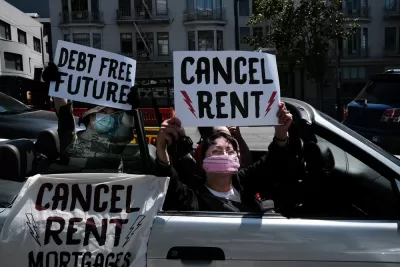
Unemployment is at record levels, and the most vulnerable Americans are the most likely to be impacted by the economic crisis. But so far, in the aggregate at least, it seems like renters are holding up better than many feared possible at the outset of the pandemic.
"The National Multifamily Housing Council (NMHC) found that 80.2% of apartment households made a full or partial rent payment by May 6 in its recent survey of 11.4 million units of professionally managed apartment units across the country," reported Brenda Richardson in May.
But every passing month of steep unemployment deepens the risk of a widespread rental payment crisis, and some sources are continuing to sound alarms about the potential for a wave of evictions to destroy lives and upend the real estate market.
Sarah Mervosh writes on this theme for The New York Times as about half of the states in the country prepare to remove eviction protections.
In many places, the threat has already begun. The Texas Supreme Court recently ruled that evictions could begin again in the nation’s second-largest state. In the Oklahoma City area, sheriffs apologetically announced that they planned to start enforcing eviction notices this week. And a handful of states, like Ohio, had few statewide protections in place to begin with, leaving residents particularly vulnerable as eviction cases stacked up or ticked forward during the pandemic.
According to Mervosh, this crisis could have the same level of impact as the housing market collapse of the Great Recession, but this time renters will be on the frontlines of the devastation.
Another article by Dima Williams raises the possibility of the worst having yet to come for renters and landlords, and there are other data reports on the state of the market that indicate a growing pressure for many renters. According to LeaseLock, a lease insurance provider, for instance, "the share of residents paying partial rent has grown month-to-month in large metros such as Atlanta, L.A. and Seattle," according to Williams.
June rent is still being sorted out amidst a rolling and explosive wave of protests, and the threat of one crisis spilling over into yet another crisis will persist. A recent study published by researchers at the University of California, Los Angeles provides recommendations for policy responses to the looming rent and eviction crisis.
FULL STORY: An ‘Avalanche of Evictions’ Could Be Bearing Down on America’s Renters

Real Estate Defaults Are Coming. Don’t Waste Them.
Here’s what the federal government should do to grab the opportunity to create affordable housing.
U.S. Mortgage Delinquencies Spike
The popularity of the mortgage forbearance program enabled by the CARES Act is one reason not to fear a housing crash like the Great Recession, yet.
Federal Eviction and Foreclosure Moratorium Extended Until the End of August
Breaking news: a federal moratorium on evictions and foreclosures of single-family mortgages backed by Fannie Mae and Freddie Mac will be extended until at least the end of August. The moratorium had been set to expire at the end of June.

Planetizen Federal Action Tracker
A weekly monitor of how Trump’s orders and actions are impacting planners and planning in America.

The state-sanctioned urbicide of Austin
People don’t kill cities. Freeways do.

US to reduce Colorado River water deliveries to Mexico
A new Colorado Treaty amendment reduces Mexico’s Colorado River water allocation by 250,000 acre feet.

5 New England states march closer to 800 megawatt wind energy project
Securing federal approval for the project may be complicated under the Trump administration, which has historically been hostile towards domestic wind power.

Baltimore to break ground on $50 million Transit Priority Project
The project will bring faster bus trips, safer streets and better bike connections to Baltimore.

Airbnb launches $250 million 'last-dollar financing' housing accelerator, makes first investment in Austin
The company will put $6.4 million towards affordable housing development in Texas’ capital.

FREE Course: Walkable City 1: Why Walkability?
After describing his path towards focusing on walkability as the essence of good planning, Jeff Speck marches through his five principal reasons for making more walkable places.
Reinventing Malls: Planning Alchemy—Turning Gray Fields Into Gold
The course focuses on the opportunities and imperatives that shape reinvention of mall sites.

Eagle County Government
Harvard University Graduate School of Design
Nashville Planning Department
The Architects Foundation
University of Cincinnati Online
The Pocatello Development Authority
The Urban Renewal Agency of the City of Pocatello
Journal of the American Planning Association