"Popular games that invite players to take on the role of developer or city planner are a familiar part of the cultural landscape," according to this article.



Emma Zehner shares insight into a game developed by Carlos Morales-Schechinger and Martin Smolka to teach the principles of land markets. The name of the game: GIROS, which in Spanish means both "transaction" and "turning around," according to Zehner.
"GIROS has been played well over 150 times and inspired spinoffs in most of Latin America, and in the Netherlands, Taiwan, Ghana, Kenya, the Philippines, and other countries. Participants have ranged from urban planning students to high-level public officials."
"Depending on the decisions players make, the game can take many forms. But at least two takeaways, evident since the game’s origins, always emerge. The first is that land value is not intrinsic, but is instead shaped by factors including transportation costs, land use regulations, taxation, and other externalities. The second takeaway, which the Lincoln Institute is fully embracing as part of its current instructional design work, is that games are a seriously important part of land policy education."
Zehner is writing for the Lincoln Institute of Land Policy, so the article is, to a degree, promotional of the agenda and programs of that organization, but the lessons of this examination should be apparent to a broad planning-interested audience. We've all played Monopoly, after all.
Monopoly was created in 1903 by Henry George aficionado Elizabeth Magie, then bought by the Parker Brothers in the 1930s and transformed into the capitalist game known around the world today. More modern digital games like SimCity, in which players build and manage urban areas, and Minecraft, which places players in an undeveloped landscape with the tools they need to build cities and other structures, have kept the tradition going.
There are more examples of planning-related games of varying levels of popularity to be listed, but the idea of games and play hasn't yet found traction in planning pedagogy commensurate with its potential. Making more use of games could fill significant gaps in the planning curricula all over the world, including in the United States.
Read the full story: Game Time: Active Learning Puts a Spin on Urban Planning Education

Why Aren’t There More Planners?
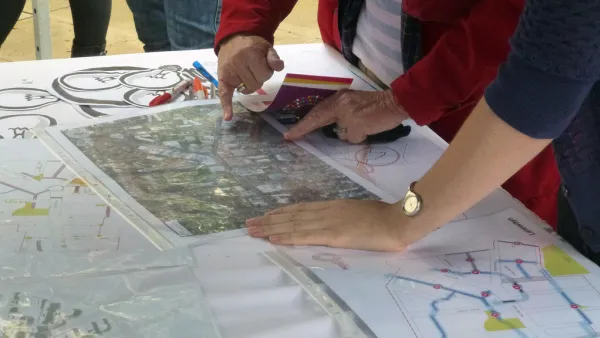
Planning can be a great career for socially conscious individuals, but university programs are struggling to attract new students to the field. A trio of academics are raising awareness about the field through community activation.
The Top Schools For Urban Planners
The 7th Edition of the Planetizen Guide to Graduate Urban Planning Programs, now available, includes an updated ranking of the Top 25 master’s programs in urban planning, city planning, regional planning, and community planning.

The Top Planning Courses of 2022
A list of the top planning education resources, according to the users of Planetizen Courses.

Planetizen Federal Action Tracker
A weekly monitor of how Trump’s orders and actions are impacting planners and planning in America.

The state-sanctioned urbicide of Austin
People don’t kill cities. Freeways do.

US to reduce Colorado River water deliveries to Mexico
A new Colorado Treaty amendment reduces Mexico’s Colorado River water allocation by 250,000 acre feet.

Brightline West’s future may rely on $6 billion federal loan
The company has until Nov. 2 to make a $400 million equity investment into its proposed high-speed rail line.

LA Metro’s ultimatum: no extra buses for LA28 if federal funding isn’t imminently secured
If Metro does not provide additional buses, LA28 organizers will have to find a new way to manage Olympic traffic. LA28’s budget does not include a line item for transit.

Colorado’s Largest Data Center Could Rise Next to Homes — Without a Public Hearing
The proposed campus would consume 11 times the power of Denver International Airport; as it has across the country, opposition mounts.

FREE Course: Walkable City 1: Why Walkability?
After describing his path towards focusing on walkability as the essence of good planning, Jeff Speck marches through his five principal reasons for making more walkable places.
Reinventing Malls: Planning Alchemy—Turning Gray Fields Into Gold
The course focuses on the opportunities and imperatives that shape reinvention of mall sites.

Eagle County Government
Harvard University Graduate School of Design
Nashville Planning Department
The Architects Foundation
University of Cincinnati Online
The Pocatello Development Authority
The Urban Renewal Agency of the City of Pocatello
Journal of the American Planning Association