The agency wants to increase service and extend its infrastructure to move Caltrain from a commuter rail system to an integrated urban transit network.


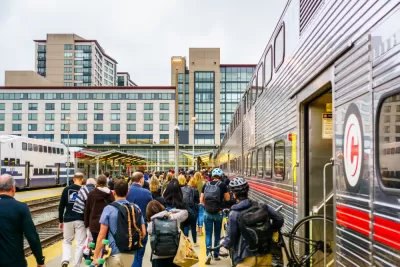
Erin Baldassari reports on new expansion plans for Caltrain in the San Francisco Bay Area as the region anticipates significant population growth in the future and the need for a more extensive transit network. "Caltrain’s vision contemplates BART-like 'show-up and go' service, whisking passengers from San Francisco to Gilroy on trains that run at least every 15 minutes all day long."
Caltrain expects that increasing service frequently and capacity would boost ridership from 65,000 daily riders to 180,000. This would give commuters more travel options and decrease traffic congestion and pollution in the region, say advocates. The agency is also looking at a slew of capital projects, along with the addition of electric trains, which operate faster than diesel trains.
But, says Baldassari, the price tag for these upgrades is high, including $90 million a year in operating subsidies. Possible funding sources include a multicounty sales tax increase and a regional transportation funding measure.
"The region is only going to continue to grow, said Adina Levin, the co-founder of Friends of Caltrain, a transit advocacy organization. So why not aim high, she said, even if the vision isn’t ultimately achieved due to factors outside of Caltrain’s control, such as the fate of high-speed rail."
FULL STORY: Caltrain has an ambitious plan to run BART-like service. Here’s what it will mean for Bay Area traffic

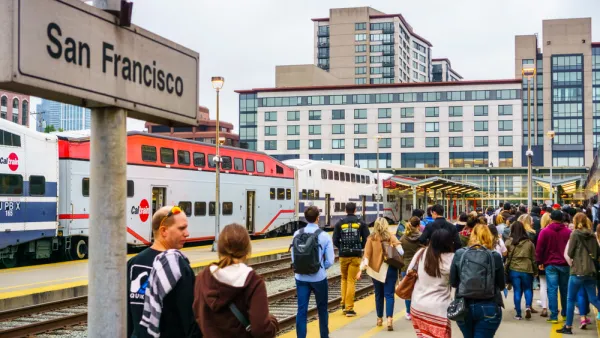
Compromise Reached to Save Caltrain
The saga of the three-county sales tax upon which the future of Caltrain depends is now in the hands of voters.
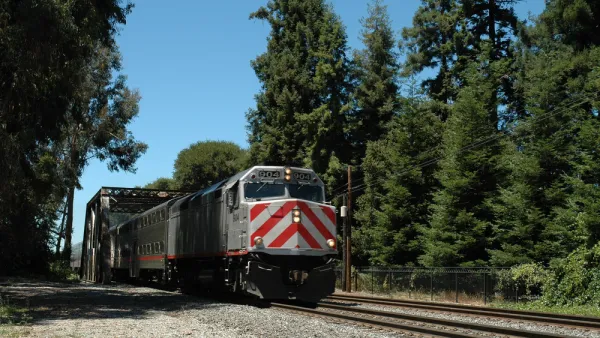
Caltrain on the Rocks as Sales Tax Measure Fails
Advocates are concerned about the possibility of Caltrain entirely shutting down—less than a year after the commuter rail line seemed positioned for a massive expansion of service.

Despite 47% growth in ridership, Caltrain could close a third of its stations
Riders can currently travel up to 79 miles between San Francisco and Gilroy, California.

Planetizen Federal Action Tracker
A weekly monitor of how Trump’s orders and actions are impacting planners and planning in America.

The state-sanctioned urbicide of Austin
People don’t kill cities. Freeways do.

US to reduce Colorado River water deliveries to Mexico
A new Colorado Treaty amendment reduces Mexico’s Colorado River water allocation by 250,000 acre feet.

5 New England states march closer to 800 megawatt wind energy project
Securing federal approval for the project may be complicated under the Trump administration, which has historically been hostile towards domestic wind power.

Baltimore to break ground on $50 million Transit Priority Project
The project will bring faster bus trips, safer streets and better bike connections to Baltimore.

Airbnb launches $250 million 'last-dollar financing' housing accelerator, makes first investment in Austin
The company will put $6.4 million towards affordable housing development in Texas’ capital.

FREE Course: Walkable City 1: Why Walkability?
After describing his path towards focusing on walkability as the essence of good planning, Jeff Speck marches through his five principal reasons for making more walkable places.
Reinventing Malls: Planning Alchemy—Turning Gray Fields Into Gold
The course focuses on the opportunities and imperatives that shape reinvention of mall sites.

Eagle County Government
Harvard University Graduate School of Design
Nashville Planning Department
The Architects Foundation
University of Cincinnati Online
The Pocatello Development Authority
The Urban Renewal Agency of the City of Pocatello
Journal of the American Planning Association