A scooter vigilante's activities in Scottsdale were short lived. A local columnist has an ambivalent take on the story.


Joanna Allhands pens an opinion piece on the subject of Michael Smalley, who took a vigilante's to approach to scofflaw scooter users by impounding scooters and holding them for ransom. The idea wasn't unique to Smalley, who registered a business in Scottsdale to do the work of taking scooters ransom. Another company in San Diego attracted a lawsuit earlier this year for similar activities.
According to Allhands, Smalley was both wrong, and a folk hero.
Smalley, like many of us, was tired of seeing scooters turn up in the most annoying places. Like, oh, say, in the middle of the sidewalk.
But he didn’t just walk by and get annoyed, or silently curse companies for using public right of way to make money. He didn’t even report it to the city in hopes that some code enforcement officer would spring into action.
No. He impounded the darned things. Smalley even registered a business with Scottsdale to do this kind of work.
Smalley didn't ask permission, however, to impound private property, and has backed down from the practice since police were notified.
Allhands is clearly not a fan of scooters, if the editorializing apparent in the above quote didn't make clear.
Read the full story: Scottsdale's scooter vigilante was wrong ... and still satisfyingly right
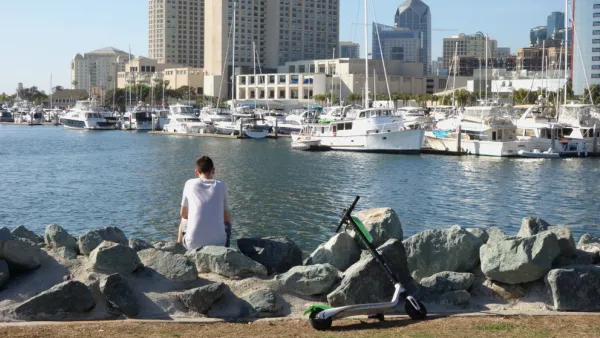
A Company of Scooter Vigilantes Sparks a Lawsuit
A lawsuit by Bird and Lime against the company Scooter Removal highlights the difficult challenges required to reconcile the private interests of new mobility companies with the access to the public realm on which they depend.
Scooter-Share Company Tosses Financial Reports
Bird was counting money in customers’ digital “wallets” as revenue, and has admitted that financial statements from 2020 and 2021 “should no longer be relied upon.”
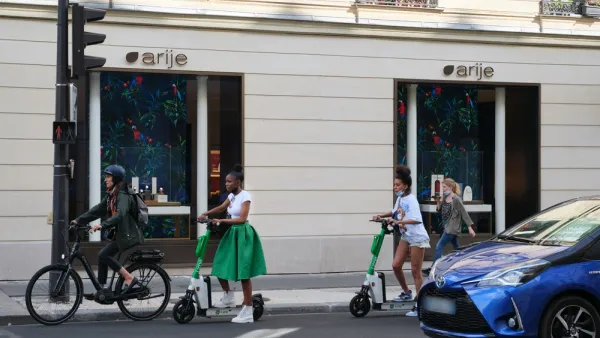
The Electric Scooter Rebound
The nascent electric scooter rental industry came close to total collapse during the pandemic, but riders are back in bigger numbers than ever and the companies hope to build momentum on growing concerns about the climate impacts of transportation.

Planetizen Federal Action Tracker
A weekly monitor of how Trump’s orders and actions are impacting planners and planning in America.

California plans to bury El Niño’s downpour
If the state plays its cards right, it may be able to store a billion acre-feet of El Niño’s water in aquifers.

Desperate measures: Advocates weigh draining Lake Powell to fill Colorado River
Draining the reservoir could reduce evaporation losses by a couple hundred thousand acre-feet.

Los Angeles just elected an urban planner as its mayor
Transportation analysts are optimistic that Raman will be more aggressive in addressing transit issues than Bass.

Mamdani’s pied-à-terre tax survives legal challenge
A panel of judges found that the plaintiffs failed to demonstrate injury as a result of New York City's implementation of the tax.

Eastern Nebraska is running out of electricity
Data centers and electrification are straining eastern Nebraska’s grid, throttling economic development.

FREE Course: Walkable City 1: Why Walkability?
After describing his path towards focusing on walkability as the essence of good planning, Jeff Speck marches through his five principal reasons for making more walkable places.
Reinventing Malls: Planning Alchemy—Turning Gray Fields Into Gold
The course focuses on the opportunities and imperatives that shape reinvention of mall sites.

City of Rosemead
Rutgers University, Edward J. Bloustein School of Planning and Public Policy
One Hundred Miles
University of Michigan School for Environment and Sustainability (SEAS)
Hunter College, City University of New York (CUNY)
The Architects Foundation
City of Cambridge
Montrose County
The Pocatello Development Authority