The company that best understands what drives city residents’ decisions is best suited to untangle persistent urban problems.


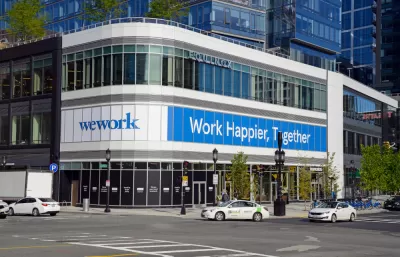
What kind of mindset and expertise, and thus what type of company, is best suited to succeed in the growing merger between tech companies and city management? The We Company and Lyft both recently dove headlong into the complex world of urban problem solving, following in the footsteps of Alphabet (who has has already tried their hand with Sidewalk Labs in Toronto) and Airbnb (who opened their own internal urban planning shop, Samara, in 2016). The fundamental challenges that We Company and Lyft were designed to solve will take them in different directions.
To summarize recent news, in conjunction with their recent IPO, Lyft has launched an initiative called City Works (which if you operate in the field, you will immediately confuse with a thousand other similarly named organizations). According to press releases, City Works will donate $50 million or 1% of Lyft’s profits, whichever is greater, to cities around the country to support local transportation initiatives that improve equity and access.
Taking a different approach, The We Company (née WeWork) has hired a fleet of designers to extend its reach beyond the walls of its work spaces (or fitness centers, or any of the other recent spinoffs) into the city at large. Leadership additions include Di-Ann Eisnor, formerly the head of growth at Waze and known for an analytical bent, and architect and big thinker Dror Benshetrit, known for creative, if outlandish, proposals. These new hires arrive on the heels of bringing in starchitect Bjarke Ingels as the company’s chief architect. No shortage of big thinkers. As compared to Lyft, it’s less clear what The We Company is aiming to achieve with these additions.
While both companies will clearly be using data captured from users to identify efficiencies (Lyft already tracks its users’ travel patterns and The We Company recently acquired spatial analytics company Euclid, which tracks movements inside buildings), there is a fundamental difference between Lyft and The We Company.
Lyft’s primary business is solving an engineering problem: where people travel and how they get there. Of the range of choices that people in cities make on a daily basis, the most rational one—the one most similar to an engineering problem—is how to travel. While a minority will choose a route based on view, or the pleasantness of the experience, the vast majority of city dwellers look at the information available to them and choose how to get from A to B based exclusively on trip length. Which is to say that people’s commute decisions differ from almost every other complex, abstract, and social decision that they make all day long. Transportation decisions are the exception to the rule of human nature.
The We Company, on the other hand, is in the business of creating communities. The primary benefit they offer is a (partial) solution to loneliness and dislocation. For all the freedom that freelancing offers, the one thing it eliminates is a collegial work environment. Hence co-working’s rapid rise—it re-creates the social benefits of an informal office environment without the negatives of a hierarchy. And in the service of improving their product, The We Company pays very close attention to the messier side of human decision making. What attracts people to congregate in certain places in an office or building? Is it the layout, the activities on offer, the types of people nearby, or other amenities? Acquiring Euclid gives The We Company fine grained information to help untangle exactly that.
In their search for the magic to the secret sauce of human congregation, The We Company is far better suited to improve cities, because the question they’re asking is far more complex and anthropological than Lyft's. The fundamental crises that cities face today are not infrastructure-based, they are the sticky social and emotional problems that revolve around equity and insecurity and fairness: policing, persistent segregation of schools and communities, and gentrification, to name a few. Lyft will undoubtedly be able to make a positive impact through their donations and collaborations—god knows cities haven’t mastered access issues yet—and they should be applauded, but the approach they bring with them from inception will only take them so far.
The We Company, on the other hand, is merely scaling up. Instead of untangling social interaction on a small, office-sized, scale, they are applying what they’ve already learned to a larger but similar target. It will be tempting to follow the tech herd and get lost in the data, especially with their acquisition of Euclid, and The We Company should be careful not to be lured into believing that data aggregation will unlock the secret to vibrant cities. They should stick with what they know best from their existing body of work: that the complexity and delight of cities comes from the overlay of millions of people making far more complex emotional decisions about what makes them feel good.
Lev Kushner is a founding partner at Department of Here, an urban brand strategy agency that helps give definition and meaning to the places people care about.


The Smart Cities Revolution Happened, but Cities Were Left Out of Loop
Cities have transformed in profound ways, but more recent changes were the last part of a series of technology waves.

WeWork's Real Estate Arm Launches 'Future Cities' Initiative
Another buzzy tech company with roots in the real estate market has designs on the "smart cities" revolution.
Salt Lake City debuts new bus rapid transit line
The third BRT line in the Utah Transit Authority system connects destinations from Taylorsville to the West Valley.

Planetizen Federal Action Tracker
A weekly monitor of how Trump’s orders and actions are impacting planners and planning in America.

HUD modernizes 50-year-old manufactured housing framework
The Next Generation Manufactured Housing Action Plan establishes new energy-efficiency standards for manufactured homes, and new guidelines for anchoring them.

Data reveals that NYC’s bet on congestion pricing has paid off
After almost two years of the program, reports show positive impacts on traffic and air quality and no disruptions to parking.

Despite tough talk from Abbott and Paxton, Texas penalties for data center violations are light
Texas officials are promising tougher enforcement on data centers, but the existing law may offer limited leverage over the industry that has largely failed to report its water use.

How Chicago, New York and Seattle are funding transit projects amid tough times
Notes from the American Public Transportation Association's TransForm conference in Chicago.

Transport for London tackles hate crime spike with free bystander training
Recorded hate crime offences on the London's transport network have increased by 36 per cent.

FREE Course: Walkable City 1: Why Walkability?
After describing his path towards focusing on walkability as the essence of good planning, Jeff Speck marches through his five principal reasons for making more walkable places.
Reinventing Malls: Planning Alchemy—Turning Gray Fields Into Gold
The course focuses on the opportunities and imperatives that shape reinvention of mall sites.

One Hundred Miles
County of Mendocino
planning NEXT
The Architects Foundation
University of Cincinnati Online
Montrose County
Northern Illinois Transit Authority (NITA)
The Pocatello Development Authority

