With President Trump in Florida, Diane Yentel writes about the many people there still living without shelter after Hurricane Michael last year.


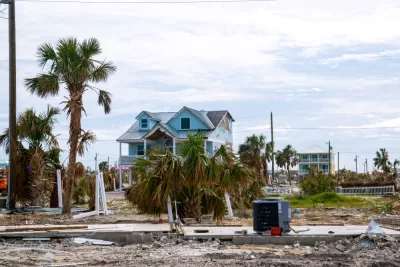
Diane Yentel, president and CEO of the National Low Income Housing Coalition, pens an opinion piece for the Orlando Sentinel to raise alarms about the lack of federal action in response to housing needs following Hurricane Michael, seven months ago.
"FEMA’s inexplicably and unacceptably slow response leaves thousands of low-income survivors continuing to sleep in tents, cars, doubled or tripled-up with other low-income families, or paying more than half of their incomes on rent, putting them at increased risk of evictions and homelessness," according to Yentel.
Among the distressing statistics shared by Yentel: Bay County, Florida reports that 5,000 children are now homeless as a result of the storm.
According to Yentel, the lack of response is a pattern evident in FEMA's response to Hurricane Harvey in Houston, Hurricane Florence, Hurricane Maria, and wildfires in California.
"After each disaster, FEMA consistently refused to provide critical housing solutions, like the Disaster Housing Assistance Program (DHAP), to help the most-vulnerable survivors get back on their feet," according to Yentel. "Instead, FEMA forced thousands of struggling families to live out of motel rooms through its Transitional Shelter Assistance (TSA) program. In doing so, the agency relied on a program that, by design, prevents many of the lowest-income people from receiving help altogether."
Read the full story: Housing coalition chief: Trump has inept response to Panhandle crisis

ExxonMobil's $1 Million Gift to Fight Climate Change Through Carbon Pricing
Two days after a Nobel prize was awarded to William Nordhaus for his work on carbon taxes to address climate change, the largest American oil and gas company announced a $1 million contribution to a group promoting a carbon fee and dividend plan.

Extreme weather is weakening social connections
Extreme heat, flooding and other weather events are increasing isolation and fraying social ties.

Arizona had its hottest spring in 131 years
Average March temperatures across the state were 12.5 degrees above normal.

Planetizen Federal Action Tracker
A weekly monitor of how Trump’s orders and actions are impacting planners and planning in America.

California plans to bury El Niño’s downpour
If the state plays its cards right, it may be able to store a billion acre-feet of El Niño’s water in aquifers.

Desperate measures: Advocates weigh draining Lake Powell to fill Colorado River
Draining the reservoir could reduce evaporation losses by a couple hundred thousand acre-feet.

Chicago voters approve permanent festival grounds, penalty for vacant property owners
Currently, major summer and fall festivals take over public parks for weeks at a time, drawing criticism from nearby residents

NYC votes to cut outdoor dining red tape, speed up permitting
New York City also voted to allow the Department of Transportation to begin work on urgent projects before notifying elected officials.

California appears to reject Prop. 45
The proposition would have expanded the projects that qualify for a streamlined environmental review, effectively paring down the California Environmental Quality Act.

FREE Course: Walkable City 1: Why Walkability?
After describing his path towards focusing on walkability as the essence of good planning, Jeff Speck marches through his five principal reasons for making more walkable places.
Reinventing Malls: Planning Alchemy—Turning Gray Fields Into Gold
The course focuses on the opportunities and imperatives that shape reinvention of mall sites.

City of Rosemead
Rutgers University, Edward J. Bloustein School of Planning and Public Policy
One Hundred Miles
Hunter College, City University of New York (CUNY)
The Architects Foundation
University of Cincinnati Online
City of Cambridge
Montrose County
The Pocatello Development Authority