Duke University will not sign an agreement for a regional rail project that has widespread support from the campus community.


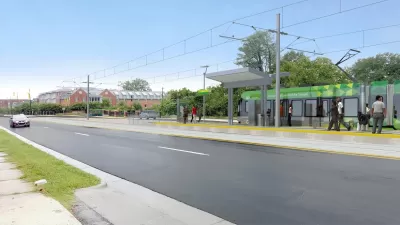
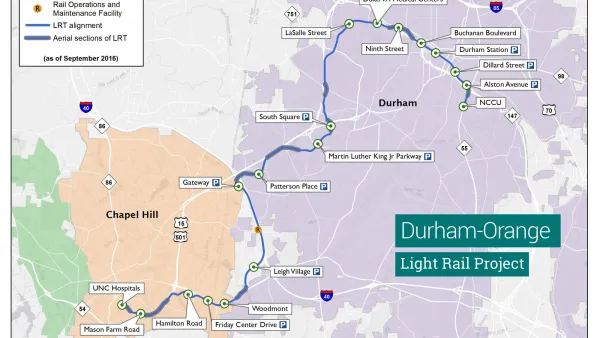
On February 27, Duke University announced it would not sign a cooperative agreement for the Durham-Orange light rail project, a $3.3-billion, 17-mile rail line that would connect UNC-Chapel Hill, Duke, downtown Durham, and North Carolina Central University.
Ahead of the decision, 51 Duke faculty and staff signed onto a letter urging the university to support the project. The letter outlines the various benefits the rail line would bring to the region, including affordable housing, access to jobs and education, and improved air quality.
The university has raised a series of concerns about the rail project, but GoTriangle, the regional transit agency, says it has worked to address these issues. "For example, to quiet concerns Duke officials had about electric power connections with Duke Medical Center, GoTriangle added a $90-million elevated portion for the light rail," reports Angie Schmitt.
GoTriangle and Durham County officials are asking Duke to participate in a mediation process to address the university’s concerns.
FULL STORY: Duke Climate Scientist Criticizes the University’s Light Rail Obstructionism

Research Triangle Commuter Rail Studied
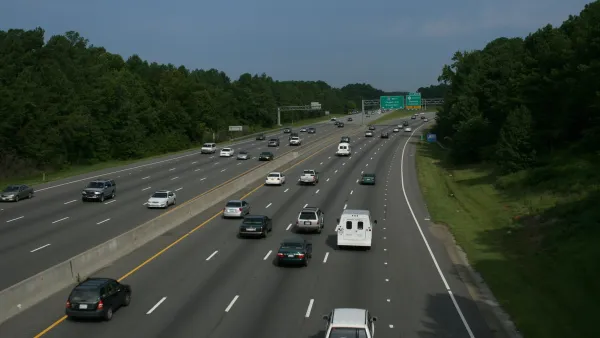
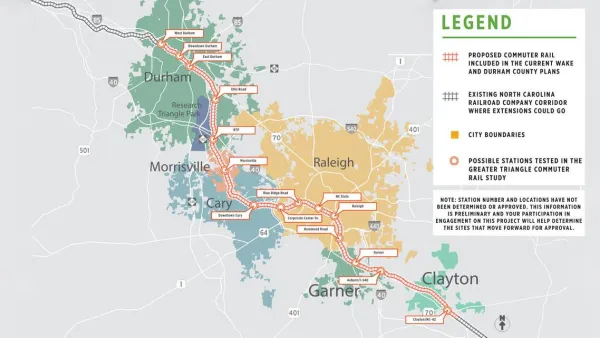
A 37-mile commuter rail line under study in North Carolina could connect cities Raleigh, Cary, and Durham in North Carolina, but the system will cost a pretty penny, and it will have to succeed where light rail previously failed.
Light Rail From Durham to Orange Finds Final Funding Piece
Planners behind a new 17-mile light rail system that will connect the cities and employers in the Research Triangle in North Carolina overcame a change of funding plans by the state.
FTA Rejects North Carolina Commuter Rail Funding
As commuter patterns shift, so too do the transit funding preferences of the federal government.

Planetizen Federal Action Tracker
A weekly monitor of how Trump’s orders and actions are impacting planners and planning in America.

The state-sanctioned urbicide of Austin
People don’t kill cities. Freeways do.

US to reduce Colorado River water deliveries to Mexico
A new Colorado Treaty amendment reduces Mexico’s Colorado River water allocation by 250,000 acre feet.

5 New England states march closer to 800 megawatt wind energy project
Securing federal approval for the project may be complicated under the Trump administration, which has historically been hostile towards domestic wind power.

Baltimore to break ground on $50 million Transit Priority Project
The project will bring faster bus trips, safer streets and better bike connections to Baltimore.

Airbnb launches $250 million 'last-dollar financing' housing accelerator, makes first investment in Austin
The company will put $6.4 million towards affordable housing development in Texas’ capital.

FREE Course: Walkable City 1: Why Walkability?
After describing his path towards focusing on walkability as the essence of good planning, Jeff Speck marches through his five principal reasons for making more walkable places.
Reinventing Malls: Planning Alchemy—Turning Gray Fields Into Gold
The course focuses on the opportunities and imperatives that shape reinvention of mall sites.

Eagle County Government
Harvard University Graduate School of Design
Nashville Planning Department
The Architects Foundation
University of Cincinnati Online
The Pocatello Development Authority
The Urban Renewal Agency of the City of Pocatello
Journal of the American Planning Association