Companies are marketing battery-electric buses as the transit vehicles of the future, but there is still much room for improvement.


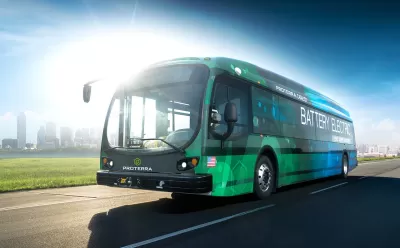
Alon Levy reports that cities in the United States and Europe are starting to look at battery-electric buses (BEBs) as an environmentally friendly, zero-emissions alternative for their fleets.
However, the performance of BEBs in cities across the country has been inconsistent. Battery range has been a big issue, with BEBs not able to travel nearly as far as fuel-powered buses. The need to recharge during the day is costly and labor intensive, and buses out of commission for charging means more vehicles are needed to maintain the same capacity.
BEBs also appear to have problems both in cold and hot weather, when batteries drain more quickly and vehicles subsequently struggle with a decrease in range.
One alternative is in-motion charging (IMC), which involves outfitting a trolleybus with a small battery and allows the vehicles to go off-grid. IMC is gaining ground in Europe, but the focus in the United States has remained largely on BEBs, says Levy.
While IMC does require overhead wire, Levy notes that BEB technology does not appear ready for widespread use. He suggests that American cities instead follow the lead of European cities putting in trolleybus networks with IMC.
FULL STORY: The Verdict's Still Out on Battery-Electric Buses

San Francisco's Electric Bus Pollution Problem
There are no emissions of pollutants or noise from these electric buses that receive power from overhead wires; but it's the wires that are viewed by some as visual pollution. Powered from the city's hydroelectric dam, they are truly carbon-free.
What's Hindering Regional Transportation in the U.S.?
Public transportation that serves regional areas makes sense, but the United States has been slow to pursue strategies and policies that foster these types of systems.

U.S. Lagging in Making Streets Safer for Pedestrians
Pedestrian deaths are on the rise in the United States, but cities have been slow to implement effective policies and road design measures to change the trend.

The state-sanctioned urbicide of Austin
People don’t kill cities. Freeways do.

US to reduce Colorado River water deliveries to Mexico
A new Colorado Treaty amendment reduces Mexico’s Colorado River water allocation by 250,000 acre feet.

New Jersey’s second-largest city bans standalone data centers
Jersey City will continue to allow co-location facilities, such as those meant for research institutions that store their own data.

Amtrak not solely to blame for New Jersey commuter rail's unreliability, report finds
A new study from the Garden State Initiative found that NJ Transit’s budget grew 20% across a 4 year period, but reliability declined significantly over the same period.

EPA erases limits on planet-warming pollution from power plants
Under Monday’s plan, power plants would still have some limits on how much mercury, arsenic and other contaminants they can emit.

Phoenix announces new on-demand transit service, more frequent RAPID buses
Both new services will launch in October, and are part of Phoenix's Project Effective Access Solutions for Easing Congestion.

FREE Course: Walkable City 1: Why Walkability?
After describing his path towards focusing on walkability as the essence of good planning, Jeff Speck marches through his five principal reasons for making more walkable places.
Reinventing Malls: Planning Alchemy—Turning Gray Fields Into Gold
The course focuses on the opportunities and imperatives that shape reinvention of mall sites.


Eagle County Government
Harvard University Graduate School of Design
Nashville Planning Department
The Architects Foundation
University of Cincinnati Online
The Pocatello Development Authority
The Urban Renewal Agency of the City of Pocatello
Journal of the American Planning Association