Despite the decline in gas prices, cars are still a luxury for many low-income Americans, and low-income zip codes still tend to have low car ownership rates.



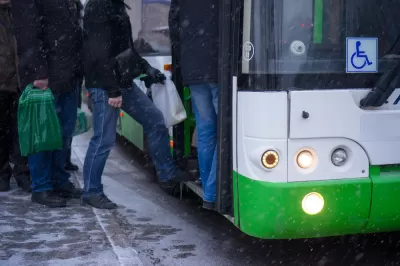
A couple of weeks ago, I read a story in the Philadelphia Inquirer: "For workers in Philadelphia’s poor neighborhoods, car ownership often a necessity and a privilege." The article, and the Twitter buzz about the article, discussed low income workers who were unable to reach jobs without cars, and claimed low-income workers can afford used cars. Certainly, this story has a grain of truth: not every job is accessible to people without cars, and there are many low-income workers who purchase them—perhaps even more so in recent years as gas prices have declined. Does this mean that there are no more carless poor, or that we don’t need to have buses and trains to accommodate them?
If that were the case, low-income neighborhoods would have car ownership rates comparable to those of other neighborhoods. But low-income neighborhoods usually do nor have car ownership rates comparable to other neighborhoods. In one of North Philadelphia’s poorest zip codes (West Philadelphia’s 19104, which has a 46 percent poverty rate), 57 percent of households do not own a car—as opposed to 31 percent for the city as a whole, and 26 percent for a richer zip code next door (19130, the Art Museum area). Similarly, in zip 19121, 51 percent do not own a car. And we don't know what the car-owning majority had to give up to afford their cars.
These areas are relatively close to Philadelphia’s flourishing downtown. What about poor areas further out? Suburbanites generally own cars—but even so, low-income suburbanites are far less likely to own cars than middle-class suburbanites. For example, Chester, Pennsylvania is a low-income suburb where only 31 percent of households lack a car. But this percentage is still far higher than the percentage for most Philadelphia suburbs. In Chester County, only 4 percent of households are carless, and in closer-in Delaware County, only 10 percent. Similarly, at the outer edges of the city of Philadelphia itself, low-income areas have more car owners than the poor areas closest to downtown, but fewer than nearby middle-class areas. For example, zip code 19120 at the city's edge has a 31 percent poverty rate and a 27 percent carless-household rate—much lower than that of close-in poor areas, but still far higher than affluent areas that are also at the edge of the city, such as zip code 19118 (11 percent carless) or 19128 (8 percent).
Of course, Philadelphia is more dense, and has better public transit, than most cities. What about car-dependent cities like Atlanta? Zip code 30314 contains Vine City, one of Atlanta’s poorest neighborhoods—and there 31 percent of households do not have a car, about the same as in Chester. Similarly, in downtown zip code 30303 (which has a 56 percent poverty rate) 34 percent of households have no car. By contrast, in 30309 (an affluent midtown zip code), only 8 percent of households lack cars—lower than the citywide average of 16 percent.
Similarly, in the poorest zip code of Jacksonville, Florida (32202) 38 percent of households had no cars—far below the citywide average of 8 percent, and also far below that of affluent intown zip codes such as 32207 (which includes the San Marco neighborhood just a mile from downtown, and has an 11 percent carless rate).
In sum, it is clearly the case that poverty-packed neighborhoods still have car ownership rates far below that of nearby middle- and upper-class areas. What, if anything, should be done about this, I leave for others to discuss (at least for the time being).

Study Shows Link Between Car Ownership and Decrease in Physical Activity
A study of residents in Beijing, China who became car owners indicates that they used alternative transportation modes less after buying cars.
What Do Cities With Fewer Cars Have in Common?
A new analysis looks at how income and population density are related to car ownership and some ways that the design of cities can help lessen car dependence.
Dallas Addresses Transit-Dependent Poverty
In Dallas poorer people often rely on transit, a familiar pattern throughout the United States. But when car ownership grants access to opportunity, this can be a problem.

Planetizen Federal Action Tracker
A weekly monitor of how Trump’s orders and actions are impacting planners and planning in America.

Amtrak, CN end decades-long dispute with eight-year agreement
The new operating agreement establishes an updated framework for the companies to work together, including processes to resolve disputes.

Judges permit Denver to divert 77,000 acre feet from the Colorado River for reservoir expansion
Overuse and climate change have caused the Colorado River’s water levels to plummet.

NYC DOT wants faster, more permanent street upgrades
The city is examining ways to build more concrete infrastructure without getting entangled in 'decades-long' projects.

'Something we’ve never seen before:' rising utility rates could strain city finances nationwide
Data centers, climate change and other factors have caused utility rates in the United States to increase by 38% since 2020.

Trump to overrule local leaders, lease millions of acres of America’s Pacific Island territories’ seafloors to mining companies
International law says that the Indigenous people of America’s territories have a right to prior and informed consent regarding projects that impact their countries.

FREE Course: Walkable City 1: Why Walkability?
After describing his path towards focusing on walkability as the essence of good planning, Jeff Speck marches through his five principal reasons for making more walkable places.
Reinventing Malls: Planning Alchemy—Turning Gray Fields Into Gold
The course focuses on the opportunities and imperatives that shape reinvention of mall sites.

Harvard University Graduate School of Design
KFH Group Inc.
Greater Baltimore Committee
The Architects Foundation
University of Cincinnati Online
The Pocatello Development Authority
The Urban Renewal Agency of the City of Pocatello

