Convention and arts centers are costly and lose lots of money, but cities still build and advocate for them.


Jen Fifield reports that cities across Arizona own event spaces that are expensive to build and manage and end up losing money. Mesa, Glendale, Phoenix, Tempe, and Scottsdale have public facilities whose bottom lines that have resulted in huge annual losses — from hundreds of thousands of dollars into the millions.
Cities make up the deficits through taxes and other funding. Some have turned over management to private companies or nonprofit organizations.
Arizona cities are willing to take a hit on these spaces because of what are seen as the larger benefits, says Fifield:
City officials across the Valley say looking simply at direct revenue the spaces bring in doesn't show the whole picture. The venues attract people to the city, who then spend money on food, travel and hotels. That outside revenue, city officials say, brings in more than enough to make up for the cost.
This phenomenon is not particular to Arizona. Cities across the country have ramped up construction of convention space, even when the cost is substantial and the demand is not apparent.
“[Heywood] Sanders has argued in academic papers and a book he wrote called ‘Convention Center Follies’ that although government officials always claim ancillary benefits from building, expanding and operating the spaces, they are expensive and rarely fulfill their promises,” says Fifield.
Read the full story: Phoenix-area cities want to offer space for events, but they're all losing money doing it
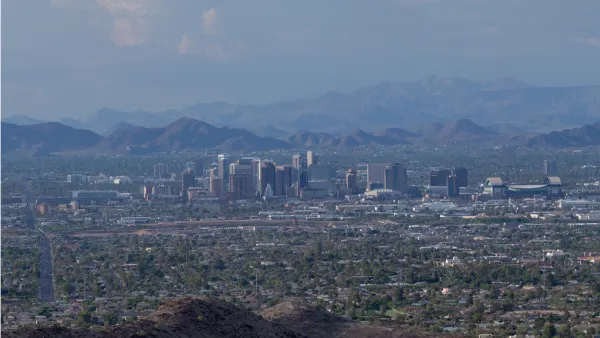
In Phoenix, Sustainability Will Be Built by Node
If the desert metropolis wants to survive, it will need a strategy built on something other than a denser, more urban downtown.
Light Rail Rides in Phoenix
After 4 years of construction, the first light rail line has opened in Phoenix. NPR looks at the new transit option for the sprawling desert city.
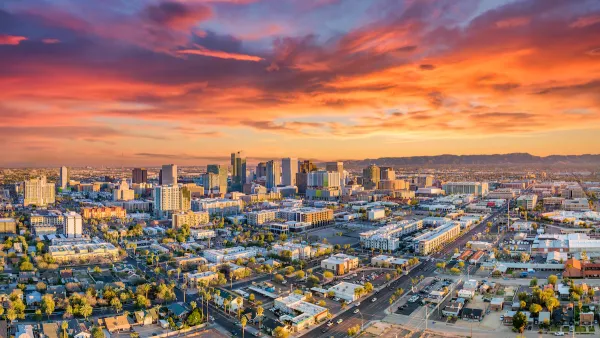
Phoenix Nonprofit Offers Medical Services to Unhoused Residents
The mobile medical units are administering IV fluids and treating heat-related illnesses as extreme heat blankets the Southwest.

Planetizen Federal Action Tracker
A weekly monitor of how Trump’s orders and actions are impacting planners and planning in America.

California plans to bury El Niño’s downpour
If the state plays its cards right, it may be able to store a billion acre-feet of El Niño’s water in aquifers.

Desperate measures: Advocates weigh draining Lake Powell to fill Colorado River
Draining the reservoir could reduce evaporation losses by a couple hundred thousand acre-feet.

Mamdani’s pied-à-terre tax survives legal challenge
A panel of judges found that the plaintiffs failed to demonstrate injury as a result of New York City's implementation of the tax.

Eastern Nebraska is running out of electricity
Data centers and electrification are straining eastern Nebraska’s grid, throttling economic development.

Seattle passes record-breaking transit services expansion
Proposition 1 will double the city’s transit tax to add 95,000 more bus trips and preserve 180,000 bus trips annually.

FREE Course: Walkable City 1: Why Walkability?
After describing his path towards focusing on walkability as the essence of good planning, Jeff Speck marches through his five principal reasons for making more walkable places.
Reinventing Malls: Planning Alchemy—Turning Gray Fields Into Gold
The course focuses on the opportunities and imperatives that shape reinvention of mall sites.


City of Rosemead
Rutgers University, Edward J. Bloustein School of Planning and Public Policy
One Hundred Miles
University of Michigan School for Environment and Sustainability (SEAS)
Hunter College, City University of New York (CUNY)
The Architects Foundation
City of Cambridge
Montrose County
The Pocatello Development Authority