A land trust is providing much-needed affordable housing relief after last year’s Hurricane Irma.


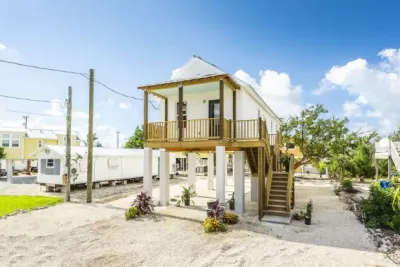
Emily Nonko reports on the efforts of the Florida Keys Community Land Trust to build affordable housing in the aftermath of Hurricane Irma. The area was already struggling with housing for low- and moderate-income residents before the hurricane, and the problem intensified after Irma destroyed a quarter of Florida Keys homes in 2017.
Nonko reports that the community land trust was founded by Maggie Whitcomb, a part-time resident of the Keys, who provided initial funding to get the project off the ground:
The trust and Monroe County also came to a unique agreement to get the project started after Whitcomb purchased the land under the trust. In Spring 2018, county commissioners approved the trust’s request for the county to purchase the trust’s first four lots at $99,999 each, in order to put nearly $400,000 toward construction of cottages.
The trust will complete four cottages this fall, with plans to finish five more by early next year. In addition to the affordable rental rates, the homes were designed for the long term. They are raised 12 feet off the ground and can withstand Category 5 hurricane winds.
Read the full story: Florida Community Land Trust Makes Affordable Housing Part of Hurricane Recovery


Denver Land Trust Fights Displacement Whether It Owns the Land or Not
Tierra Colectiva, a community land trust in the Denver neighborhoods of Globeville and Elyria-Swansea, combines community organizing, traditional CLT development, and more unusual roles in a large affordable housing development.

How a San Francisco Land Trust is Preserving Affordable Housing for Artists
The Artist Space Trust has received $10 million in properties bequeathed by artists that will become permanently affordable housing.

Detroit Launches Community Land Trust
A newly created CLT aims to support the building of affordable housing.

Planetizen Federal Action Tracker
A weekly monitor of how Trump’s orders and actions are impacting planners and planning in America.

California plans to bury El Niño’s downpour
If the state plays its cards right, it may be able to store a billion acre-feet of El Niño’s water in aquifers.

Chicago breaks ground on $3 billion megadevelopment
The new neighborhood, titled Foundry Park, will one day host 3,700 residences.

California High-Speed Rail Authority CEO resigns after $600,000 scandal
Under Ian Choudri, the authority used taxpayer dollars to fund first class flights and trips to nightclubs.

Want to study the Missouri River? Soon, you may need unanimous approval from 10 states
Legislation would require 10 governors’ permission to study or build projects moving water outside the basin.

Desperate measures: Advocates weigh draining Lake Powell to fill Colorado River
Draining the reservoir could reduce evaporation losses by a couple hundred thousand acre-feet.

FREE Course: Walkable City 1: Why Walkability?
After describing his path towards focusing on walkability as the essence of good planning, Jeff Speck marches through his five principal reasons for making more walkable places.
Reinventing Malls: Planning Alchemy—Turning Gray Fields Into Gold
The course focuses on the opportunities and imperatives that shape reinvention of mall sites.

City of Rosemead
Rutgers University, Edward J. Bloustein School of Planning and Public Policy
One Hundred Miles
Hunter College, City University of New York (CUNY)
The Architects Foundation
University of Cincinnati Online
City of Cambridge
Montrose County
The Pocatello Development Authority