Observers have been pointing out the contradictions in Secretary Ben Carson's justifications for a new approach to the Fair Housing Act.


Writers have been quick to produce commentary after news broke earlier in the week that the U.S. Department of Housing and Urban Development (HUD) had launched a rulemaking process to rewrite the Affirmatively Furthering Fair Housing (AFFH) rule approved by the Obama administration in 2015.
Henry Grabar writes for Slate, describing the action is the "firmest commitment yet to tear down the Obama-era framework for enforcing the Fair Housing Act."
Mostly, however, Grabar points out the contradictory frame HUD Secretary Ben Carson has built around his case for drawing back the AFFH rule. While Carson makes the case that the AFFH rule has made affordable housing scarcer, fair housing experts say the rule was designed to combat segregation and discrimination, not scarcity.
While Carson is on the record saying he wants to encourage development of middle-income multi-family dwellings, Grabar doesn't have to look far in Secretary Carson's past to find evidence that comment is misleading. "In his only published commentary on housing policy before his appointment to HUD, he called the 2015 AFFH rule “social engineering” that would 'fundamentally change the nature of some communities from primarily single-family to largely apartment-based areas.'"
Grabar's take: no matter how Secretary Carson justifies the need for this policy, he's pursuing the rule change for the AFFH in accordance with a traditionally conservative approach to land use and fair housing regulations, "which is to reject federal efforts to demolish the walls that wealthy white suburbs have built."
Dominique Mosbergen also followed up the news of the proposed rulemaking process by quoting Sara Pratt, a civil rights attorney and former Obama official who oversaw HUD’s enforcement of the rule and is now suing HUD for failing to implement the AFFH rule. "You’re going back to communities willfully blinding themselves to patterns of segregation," Pratt told NBC News. "Without this rule, communities will not do the work to eliminate discrimination and segregation."
Finally, Brakkton Booker also reported on the rulemaking announcement, noting that HUD will be holding "informal listening forums will be held to get input from city planners, public housing authorities, housing advocates authorities and other stakeholders on the pending rule change."
FULL STORY: Ben Carson Ends Obama-Era Efforts to Reduce Housing Segregation


Outrage Over Trump's Fair Housing Victory Lap
President Trump took to Twitter today to celebrate his administration's decision to rescind the Affirmatively Furthering Fair Housing rule, approved by the Obama administration to strengthen the Fair Housing Act of 1968.
Under Ben Carson, HUD Abdicates Fair Housing Responsibilities
Civil rights advocates are claiming that the U.S. Department of Housing and Urban Development (HUD) is no longer in the business of enforcing fair housing laws.
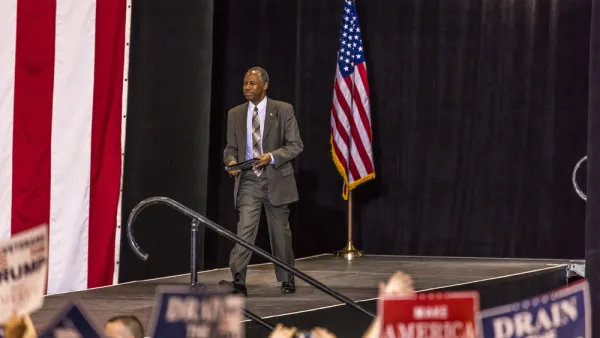
Trump Finally Follows Through on Threat to Gut Obama-Era Fair Housing Rule
It's not clear if President Trump is aware that his administration has been working to rescind the Affirmatively Furthering Fair Housing rule since 2018, but he's recently doubled down on messaging that pit suburbs against the Fair Housing Act.

Planetizen Federal Action Tracker
A weekly monitor of how Trump’s orders and actions are impacting planners and planning in America.

The state-sanctioned urbicide of Austin
People don’t kill cities. Freeways do.

US to reduce Colorado River water deliveries to Mexico
A new Colorado Treaty amendment reduces Mexico’s Colorado River water allocation by 250,000 acre feet.

5 New England states march closer to 800 megawatt wind energy project
Securing federal approval for the project may be complicated under the Trump administration, which has historically been hostile towards domestic wind power.

Baltimore to break ground on $50 million Transit Priority Project
The project will bring faster bus trips, safer streets and better bike connections to Baltimore.

Airbnb launches $250 million 'last-dollar financing' housing accelerator, makes first investment in Austin
The company will put $6.4 million towards affordable housing development in Texas’ capital.

FREE Course: Walkable City 1: Why Walkability?
After describing his path towards focusing on walkability as the essence of good planning, Jeff Speck marches through his five principal reasons for making more walkable places.
Reinventing Malls: Planning Alchemy—Turning Gray Fields Into Gold
The course focuses on the opportunities and imperatives that shape reinvention of mall sites.

Eagle County Government
Harvard University Graduate School of Design
Nashville Planning Department
The Architects Foundation
University of Cincinnati Online
The Pocatello Development Authority
The Urban Renewal Agency of the City of Pocatello
Journal of the American Planning Association