McGovern, the top Democrat on the House Rules Committee, called for “an immediate change to the status quo.”


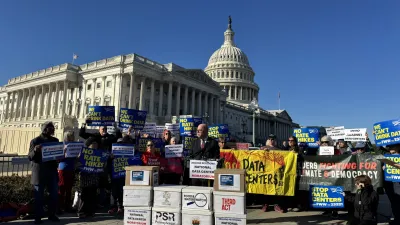
WASHINGTON — Leading and incoming U.S. House Democrats called for a national moratorium on the development of new artificial intelligence data centers Tuesday.
These centers, critical to storing the infrastructure for AI, have sparked widespread backlash over their effect on the environment and energy costs and marked a major issue in the midterm elections, where Democrats delivered a landslide majority in the House and also secured control of the Senate.
A group of members and members-elect, alongside advocates, urged passage of a measure to impose a moratorium on the construction of these centers. The bill was introduced by independent Sen. Bernie Sanders of Vermont and New York progressive Democratic Rep. Alexandria Ocasio-Cortez in their respective chambers earlier this year.
That moratorium would be imposed until “legislation is enacted that safeguards the public from the dangers of artificial intelligence,” per the text of the bill.
“We are here because it is time for Americans from across the political spectrum to stand up and to demand a nationwide moratorium on data centers,” said Rep. Jim McGovern of Massachusetts, an original cosponsor of the House version of the bill, at a press conference outside the U.S. Capitol hosted by the advocacy group Food & Water Watch.
McGovern, the top Democrat on the House Rules Committee, called for “an immediate change to the status quo.”
He rebuked President Donald Trump’s administration — which has pushed for the expansion of these centers — saying: “We are here because the alarm bells are flashing, and the president and the White House are asleep at the switch when it comes to AI.”
Rep. Chellie Pingree of Maine said data centers are “driving up the costs even further,” adding that they are “straining our grid,” “dirtying our air and water” and “degrading our health and our quality of life.”
Pingree added that “when energy prices are already sky high in places like Maine and across America, Americans don’t want data centers.”
She is the top Democrat on the House Appropriations subcommittee that oversees U.S. Interior Department funding and in line to serve as its chair in the next Congress.
New Dems
Two incoming House Democrats also called for a moratorium on new AI data centers, Reps.-elect Adam Hamawy of New Jersey and Will Lawrence of Michigan.
Hamawy said “data centers are an issue that covers so much — it covers our bills, it covers our environment, it covers our communities and our farmlands.”
He added that “the American people are really the ones who have a say in this, not the mega-corporations,” adding that “House Democrats have an opportunity to prove to the American people that we meant it when we said that we’re going to fight for them.”
Lawrence of Michigan acknowledged that AI is a “marvelous technology” and “capable of amazing things,” but said that under the current incentives, “it is going to be used to put people out of work, to harm the environment, to undermine our democracy and to put us all at terrible risk.”
Permitting reform and data centers
Meanwhile, a major bipartisan bill making its way through the Senate would overhaul the federal process for permits to construct energy projects, including data centers.
The bill, which advanced in the upper chamber Monday on an overwhelming 70-27 vote, aims to hold data centers accountable for energy costs.
Food & Water Watch — alongside other environmental groups — have vehemently opposed the bill.
In a statement earlier in November, Food & Water Watch policy director Jim Walsh said the “bad bill would only encourage and permit greater buildout of data centers and the polluting fracked gas power plants and pipelines required to serve these enormous facilities.”
Read the full story: Some US House Dems urge a national moratorium on buildup of new data centers
Did data centers change how voters cast their ballots?
Texas, Ohio, and Georgia all flipped party control. But in rural counties, the effect of local data centers was mixed.
Senate passes bill overhauling permitting
The bill still needs to pass the House.
‘Demolition of our heritage:’ Some US tribes speak out against BAAJA
A coalition of indigenous groups in the United States are concerned about provisions in the bill that may weaken their ability to halt large energy projects.

Planetizen Federal Action Tracker
A weekly monitor of how Trump’s orders and actions are impacting planners and planning in America.

Washington state to charge fee to drivers with fuel-efficient cars
Revenue from the fee will go towards supporting the state’s highways.

Illinois considers spending $1 billion in taxpayer money on data center
A quantum computing campus and data center are currently under construction in Chicago.

Some incoming, leading US House Dems urge a national moratorium new data centers
McGovern, the top Democrat on the House Rules Committee, called for “an immediate change to the status quo.”

People Mover delayed again, LAX and contractor trade barbs
The automated train was last slated to open in January 2027.

Trump to blast ‘hydrocarbon highway’ through ‘world’s longest art gallery’
Environmental and historic preservation groups are suing to stop the project.

FREE Course: Walkable City 1: Why Walkability?
After describing his path towards focusing on walkability as the essence of good planning, Jeff Speck marches through his five principal reasons for making more walkable places.
Reinventing Malls: Planning Alchemy—Turning Gray Fields Into Gold
The course focuses on the opportunities and imperatives that shape reinvention of mall sites.

City of Charlotte
City of Rosemead
Rutgers University, Edward J. Bloustein School of Planning and Public Policy
University of Michigan School for Environment and Sustainability (SEAS)
Hunter College, City University of New York (CUNY)
The Architects Foundation
University District Partnership