Under the city's proposed plan, 21% of Metropolitan Transit System riders would lose access to transit services.


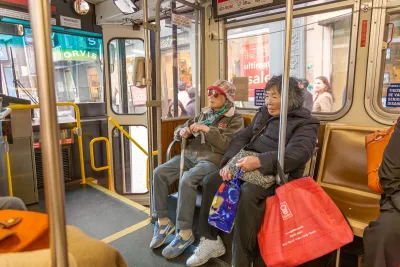
San Diego’s Metropolitan Transit System may “eliminate one-third of bus routes, reduce service on another one-third of routes and run the San Diego trolley’s four lines less frequently,” to fight off an impending budget crisis, David Garrick writes for the San Diego Union-Tribune. The city anticipates an annual budget deficit of $100 million to $150 million beginning in fiscal year 2030.
The transit company's rough-draft proposal would kill 33 of the 95 MTS bus routes, heavily reduce service on another 29 bus routes and reduce service on all four of San Diego’s trolley lines. Twenty-one percent of MTS riders would lose some form of transit service, with about 3% of riders having no nearby alternative. Roughly 36% of riders would experience reductions in service frequency.
“The bleak scenario would be necessary despite fare increases scheduled to take effect Oct. 1. But it could be avoided if MTS gets some sort of state bailout or if local voters approve a sales tax hike devoted to transit in 2028,” The San Diego Union-Tribune reports.
Read the full story: Budget deficits could wipe out one-third of bus routes, force other deep cuts to San Diego transit
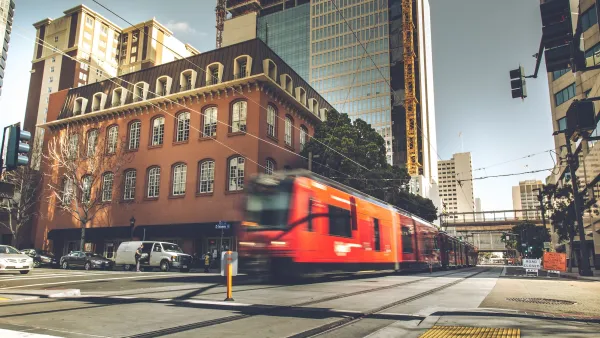
San Diego Transit Awarded $60 Million for Trolley, Electric Buses
The funding will support the electrification of San Diego’s bus system and safety and efficiency enhancements on the Orange Line trolley.
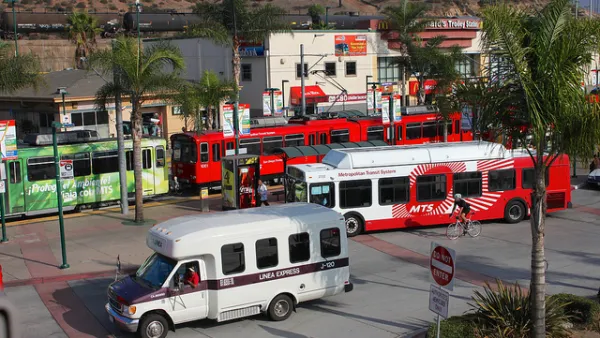
Free Transit for San Diego Youth
The Youth Opportunity Pass program provides free transit to San Diego County youth in an effort to boost ridership and improve transportation options for young residents.
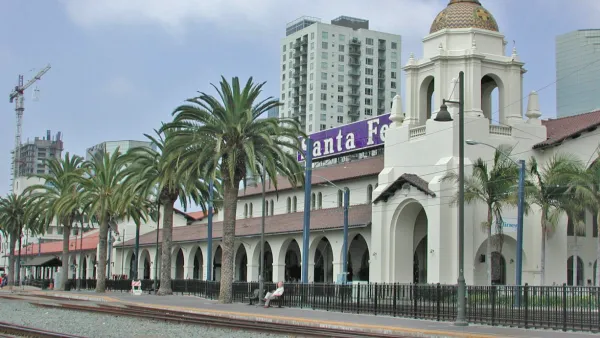
San Diego's Omission from High-Speed Rail: Customary Curse or Blessing in Disguise?
Is California's High-Speed Rail (HSR) a "boondoggle" for the state, as its critics assert, or just a boondoggle for omitted cities? How should such cities deal with omission from HSR? San Diego is a case in point.

Desperate measures: Advocates weigh draining Lake Powell to fill Colorado River
Draining the reservoir could reduce evaporation losses by a couple hundred thousand acre-feet.

Eastern Nebraska is running out of electricity
Data centers and electrification are straining eastern Nebraska’s grid, throttling economic development.

Malls are becoming the midtowns of the future
Mall and office park redevelopments are a generational opportunity to create new nodes of urbanity.

NYC breaks ground on anti-flooding infrastructure project
New York City's new system will reduce stormwater flows to local sewers by 90%.

One Kentucky town’s secret to affordable housing
The Smoketown Community Land Trust has already built seven affordable homes for community members.

Houston gains petal-shaped cooling infrastructure to make streets more ‘delightful’
The city has installed the pavilions along 15 blocks in Houston.

FREE Course: Walkable City 1: Why Walkability?
After describing his path towards focusing on walkability as the essence of good planning, Jeff Speck marches through his five principal reasons for making more walkable places.
Reinventing Malls: Planning Alchemy—Turning Gray Fields Into Gold
The course focuses on the opportunities and imperatives that shape reinvention of mall sites.

City of Rosemead
Rutgers University, Edward J. Bloustein School of Planning and Public Policy
One Hundred Miles
University of Michigan School for Environment and Sustainability (SEAS)
Hunter College, City University of New York (CUNY)
The Architects Foundation
City of Cambridge
Montrose County
The Pocatello Development Authority