Albuquerque, New Mexico and Portland, Oregon have introduced traffic lights that are red by default, and turn green faster if drivers approach while going at or below the speed limit.


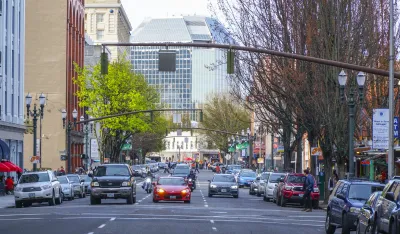
Officials in Albuquerque, New Mexico and Portland, Oregon are curbing high-speed crashes by rewarding law-abiding drivers with fewer red lights. Traffic signals in these cities default to red until a vehicle approaches, and when one does, speed sensors grant a much earlier green light to drivers traveling at or below the speed limit, Jeff McMurray writes for Next City.
Albuquerque officials credit the new strategy with a dramatic drop in crashes along the corridor they tested it on and Portland officials say the system has led to slower drivers. Next City reports:
Peter Koonce, who manages signals and street lighting for [Portland], calls the new approach a “virtual speed bump” and said the early results are promising. At the first intersection tested, rest in red was able to lower the average speed from 39 mph (63 kph) to 30 mph (48 kph), which is the speed limit, he said.
David Hurwitz, a professor of transportation engineering at Oregon State University who leads the study of Portland’s new traffic light system, said it’s too early to draw conclusions and further research is needed to ensure the positives aren’t offset by more drivers running red lights.
Read the full story: These U.S. Cities Are Rewarding Careful Drivers With Fewer Red Lights


Learning loss and urban schools, part 2
Did test scores in progressive cities drop more post-COVID than test scores in moderate ones?
Transit leaders progress high-speed rail from Portland to Vancouver, B.C.
Washington state officials may reveal feasible routes for the high-speed rail in late 2027.
Portland unveils Maine’s first affordable housing complex for LGBTQ+ seniors
The building earmarks 11 units for people with disabilities or living with HIV/AIDS.

Planetizen Federal Action Tracker
A weekly monitor of how Trump’s orders and actions are impacting planners and planning in America.

Chicago breaks ground on $3 billion megadevelopment
The new neighborhood, titled Foundry Park, will one day host 3,700 residences.

Denver is solving homelessness. Why aren't the rest of us?
Since 2023, Denver's street homeless population has decreased by 64%, proving that effective tools exist to support those in need of housing.

LA accused of breaching $1.4 billion sidewalk repair settlement
The city faces a backlog of nearly 5,000 street repair requests.

MTA kicks off six-year, $1 billion transit upgrade project
The authority is replacing the roughly 90-year-old train signals on the A and C line with modern technology.

Developers may expand largest gas pipeline network in Northwest
Pipeline giant Williams has proposed new expansions for its Northwest Pipeline from the Colorado Rockies through Idaho, Oregon and Washington.

FREE Course: Walkable City 1: Why Walkability?
After describing his path towards focusing on walkability as the essence of good planning, Jeff Speck marches through his five principal reasons for making more walkable places.
Reinventing Malls: Planning Alchemy—Turning Gray Fields Into Gold
The course focuses on the opportunities and imperatives that shape reinvention of mall sites.

City of Rosemead
Rutgers University, Edward J. Bloustein School of Planning and Public Policy
One Hundred Miles
The Architects Foundation
University of Cincinnati Online
Montrose County
Northern Illinois Transit Authority (NITA)
The Pocatello Development Authority