While the project is estimated to generate over $310 million in lease and tax payments, the funds will go to the Navajo Nation Administrative Service Centers rather than local residents.


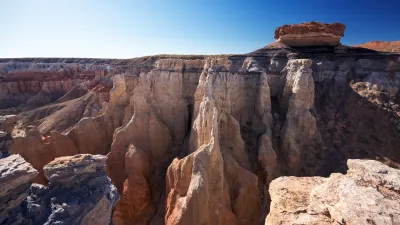
A conflict is taking place on Navajo Nation about a solar project that developers estimate will generate $310 million in lease and tax payments over 40 years — revenue that will not be directly distributed to the local community. Navajo Power PBC, a Navajo-owned, non-tribal-affiliated organization that works to bring renewable energy to tribal communities, developed the solar project in partnership with Applied Energy Services. The project aims to cover over 4,000 acres of the Coalmine Canyon Chapter of Navajo Nation in solar panels.
Because the Coalmine Canyon Chapter is an uncertified chapter of Navajo Nation, it does not control its finances. Any revenue generated by the project will be routed through the Navajo Nation Administrative Service Centers, meaning it is not guaranteed that local residents will reap the financial benefits of the solar farm. The power the project generates will also flow to an electrical grid rather than to Coalmine Canyon Chapter homes.
The residents of Coalmine Canyon Chapter received information on the project in a 60-slide Powerpoint presentation over a two-day period. Freddie Hatathlie, a lifetime resident of Coalmine Canyon, said the presentations were in English and full of industry terminology that was hard for residents to follow. Hatathlie said he felt that key decisions had already been made by the larger Navajo government, without meaningful local input.
Read the full story: Large solar project on Navajo Nation leaves residents skeptical

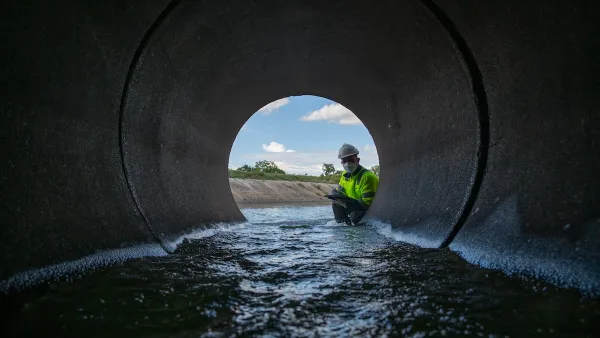
El Niño takes lives, infrastructure as U.S. storm systems prove ill-prepared
About two-thirds of America's culverts are in states with outdated design standards.
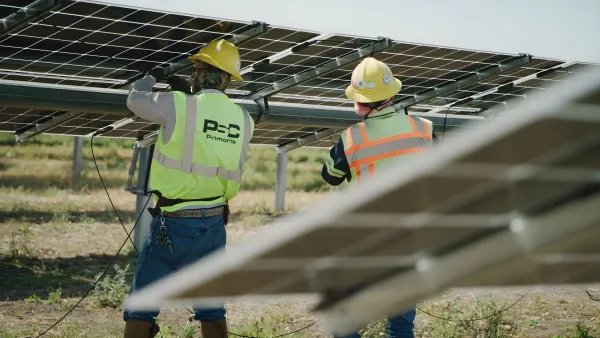
States that voted for Trump are building the majority of new solar farms
The Trump administration has made it more difficult to build solar farms on federal land, and congress has scaled back tax credits for the industry.
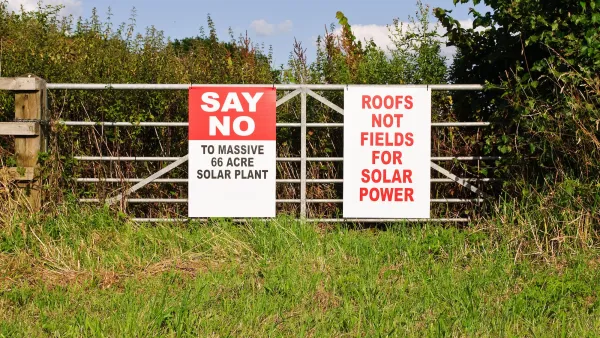
Misinformation and 'AI slop' are hamstringing rural solar development
False claims about the potential drawbacks of solar farms are prompting some communities to reject potentially lucrative energy projects.

Planetizen Federal Action Tracker
A weekly monitor of how Trump’s orders and actions are impacting planners and planning in America.

California plans to bury El Niño’s downpour
If the state plays its cards right, it may be able to store a billion acre-feet of El Niño’s water in aquifers.

Chicago breaks ground on $3 billion megadevelopment
The new neighborhood, titled Foundry Park, will one day host 3,700 residences.

California High-Speed Rail Authority CEO resigns after $600,000 scandal
Under Ian Choudri, the authority used taxpayer dollars to fund first class flights and trips to nightclubs.

Want to study the Missouri River? Soon, you may need unanimous approval from 10 states
Legislation would require 10 governors’ permission to study or build projects moving water outside the basin.

Desperate measures: Advocates weigh draining Lake Powell to fill Colorado River
Draining the reservoir could reduce evaporation losses by a couple hundred thousand acre-feet.

FREE Course: Walkable City 1: Why Walkability?
After describing his path towards focusing on walkability as the essence of good planning, Jeff Speck marches through his five principal reasons for making more walkable places.
Reinventing Malls: Planning Alchemy—Turning Gray Fields Into Gold
The course focuses on the opportunities and imperatives that shape reinvention of mall sites.

City of Rosemead
Rutgers University, Edward J. Bloustein School of Planning and Public Policy
One Hundred Miles
Hunter College, City University of New York (CUNY)
The Architects Foundation
University of Cincinnati Online
City of Cambridge
Montrose County
The Pocatello Development Authority