How to make the most of the $270 million program replacing federal EV tax credits in California.


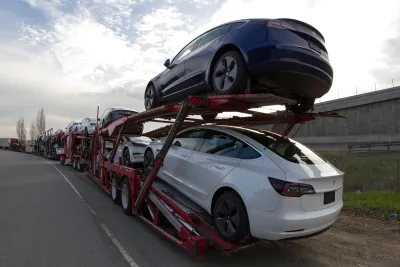
On Friday, California launched its much-awaited EV rebate program, which offers a $3500 instant rebate to residents who buy or lease a zero-emission vehicle — including electric and hydrogen fuel cell-powered vehicles. The program, announced in July, followed the end of a federal EV tax credit that previously allowed American consumers to claim $7,500 and $4,000 in tax credits for new and used EVs, respectively.
Amidst the fanfare of the program's launch, CalMatters released a practical how-to guide to accessing the rebate, including who qualifies, how to apply, what kinds of vehicles qualify, and even how low-income buyers can access additional rebates.
"The program has secured $270 million in funding — half of that from the state budget and the other from participating EV automakers," writes CalMatters. Find out how to access it in the article below.
Read the full story: How does California’s new $3,500 EV rebate work?

California launches $3,500 EV rebate
A new rebate program aims to maintain momentum for EV adoption as the federal government eliminates other incentives.
California Beats EV Adoption Goal by Over 1 Million Vehicles
The state pledged to put 1.5 million EVs on its roads by 2025.
Uber Abandons Climate Commitments, Kills EV Incentive for Drivers
The company is dropping its pledge to fully electrify its fleet by 2030 and eliminating a monthly bonus for drivers who switch to EVs.

Planetizen Federal Action Tracker
A weekly monitor of how Trump’s orders and actions are impacting planners and planning in America.

Northwest rail fans eager for Sept. 30 debut of Amtrak’s Airo fleet
Get ready for that new train smell and more seats. But they won’t go faster or run more frequently on the Cascades route in Washington and Oregon.

Alabama scores up to $2.5 billion federal loan for largest infrastructure project in state’s history
The Mobile River Bridge and Bayway Project aims to ease congestion at Alabama’s worst bottleneck.

Novel study finds extreme state-by-state disparity in housing construction timelines
The first comprehensive working paper on U.S. construction timelines also found that the permitting process for multi-family projects has slowed nationwide.

California may destroy its beaches trying to save homes from El Niño
Boulders and seawalls can protect homes from waves, but ultimately destroy sandy beaches.

California high-speed rail accomplishes only one legislative goal in 2026
The majority of the agency's failed pitches were never developed into written proposals.

FREE Course: Walkable City 1: Why Walkability?
After describing his path towards focusing on walkability as the essence of good planning, Jeff Speck marches through his five principal reasons for making more walkable places.
Reinventing Malls: Planning Alchemy—Turning Gray Fields Into Gold
The course focuses on the opportunities and imperatives that shape reinvention of mall sites.

City of Thousand Oaks
City of Wisconsin Rapids
Harvard University Graduate School of Design
The Architects Foundation
University of Cincinnati Online
Northern Illinois Transit Authority (NITA)
The Pocatello Development Authority
The Urban Renewal Agency of the City of Pocatello