Some mobility advocates say the city's 'Green Corridor' amounts to 'lipstick on a pig' rather than a true commitment to better transit and walking infrastructure.


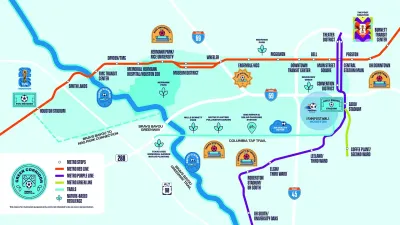
Houston's efforts to improve transit access and walkability ahead of this year's FIFA World Cup could have long-lasting impacts on the city's infrastructure.
As Michael Adkison reports for Houston Public Media, the city created a 14-mile loop dubbed the "Green Corridor" to highlight the city's car-free options. "The Green Corridor can be roughly split in two: the walkable portion on a hike-and-bike trail, and the other half following the Metropolitan Transit Authority of Harris County's light rail system." Visitors can connect to the newly pedestrianized Main Street promenade and the FIFA Fan Festival in East Downtown.
METRO has increased train frequency for the Red Line light rail, which is accessible on about half of the Green Corridor.
Some transit advocates, like Kevin Strickland of Walk and Roll Houston, say the effort is not enough and that "it feels like a bunch of existing features have been stitched together, or connected together, on a map with some lines" rather than a real effort to improve mobility. Strickland points out that summer temperatures in Houston often reach extreme highs, making walking less viable for all visitors.
FULL STORY: Houston’s World Cup officials want to make the city more walkable. Will it work?

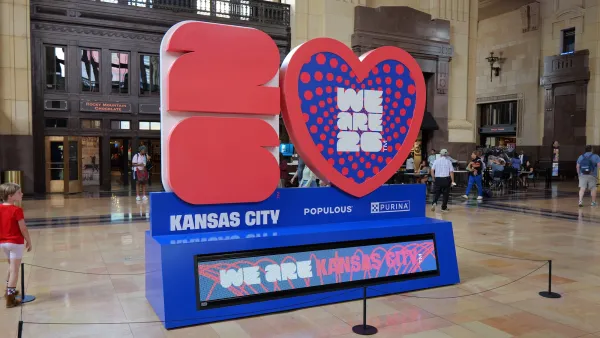
World Cup crowds offer 'stress test' for Kansas City transit planners
Transportation officials are closely monitoring travel patterns during the World Cup to understand how the city's transit system can be improved as the population grows.
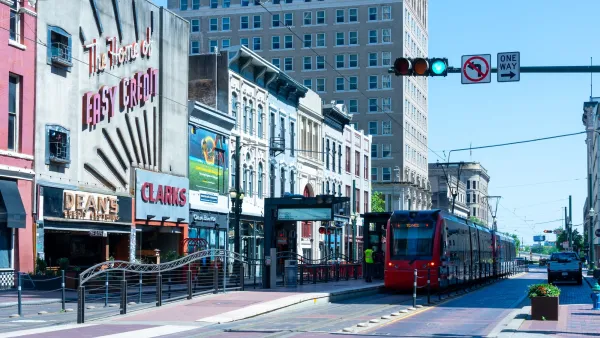
Houston's pedestrian promenade on track to be ready for World Cup crowds
The city is transforming seven downtown blocks along a light rail line into a car-free zone focused on outdoor dining and entertainment.
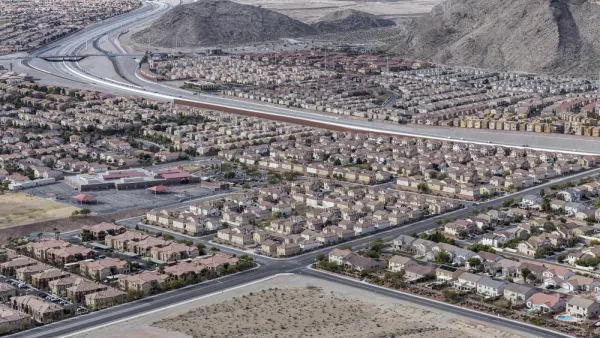
Research: Sprawl Linked to Poverty
Low-income families living in high-sprawl neighborhoods are limited in their access to education, jobs, and other amenities, often trapping them in a cycle of poverty.

Planetizen Federal Action Tracker
A weekly monitor of how Trump’s orders and actions are impacting planners and planning in America.

The state-sanctioned urbicide of Austin
People don’t kill cities. Freeways do.

US to reduce Colorado River water deliveries to Mexico
A new Colorado Treaty amendment reduces Mexico’s Colorado River water allocation by 250,000 acre feet.

5 New England states march closer to 800 megawatt wind energy project
Securing federal approval for the project may be complicated under the Trump administration, which has historically been hostile towards domestic wind power.

Baltimore to break ground on $50 million Transit Priority Project
The project will bring faster bus trips, safer streets and better bike connections to Baltimore.

Airbnb launches $250 million 'last-dollar financing' housing accelerator, makes first investment in Austin
The company will put $6.4 million towards affordable housing development in Texas’ capital.

FREE Course: Walkable City 1: Why Walkability?
After describing his path towards focusing on walkability as the essence of good planning, Jeff Speck marches through his five principal reasons for making more walkable places.
Reinventing Malls: Planning Alchemy—Turning Gray Fields Into Gold
The course focuses on the opportunities and imperatives that shape reinvention of mall sites.

Eagle County Government
Harvard University Graduate School of Design
Nashville Planning Department
The Architects Foundation
University of Cincinnati Online
The Pocatello Development Authority
The Urban Renewal Agency of the City of Pocatello
Journal of the American Planning Association