Three years after a major Supreme Court case, bills to criminalize homelessness and ban encampments have popped up widely. But here are some places that are fighting back.



Following the Supreme Court’s City of Grants Pass v. Johnson ruling, many cities and states have increased encampment removals and criminalization of homelessness. This Shelterforce/Next City article highlights the communities taking a different approach — protecting their unhoused residents.
Many of these communities are outlawing punishments for sleeping outside when there's no available shelter. The piece explores emerging legislation in places like Illinois and Pennsylvania and Connecticut’s first-in-the-nation ban on hostile architecture in public spaces. According to the article, "Proposals in multiple states have attempted to ban the practice of “hostile architecture,” or intentional design decisions that make it difficult to sit or lie down outside to dissuade homeless people from sleeping."
Read the full story: In the Shadow of Grants Pass, Some Communities Reject Homeless Crackdowns


LA has no plan — or funding — to help unhoused people displaced by Olympics security efforts
City and county officials say they don't have the funds to offer housing to the up to 1,600 people that will be displaced by perimeters around event venues.

Berkeley promised to build supportive housing in People's Park. Where is it?
More than two years after People's Park was cordoned off, there is no word on a timeline for a promised affordable housing project.
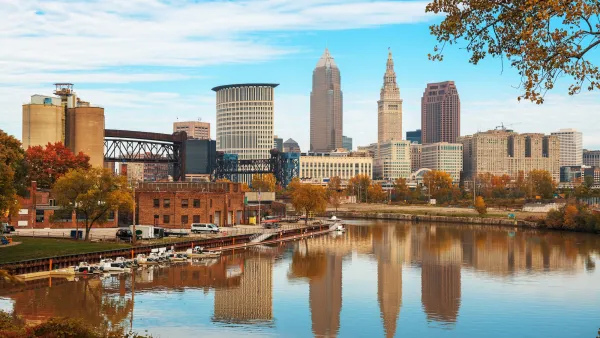
Cleveland program has housed 200 people since 2024
The A Home For Every Neighbor initiative successfully moves people into housing in under two weeks.

Planetizen Federal Action Tracker
A weekly monitor of how Trump’s orders and actions are impacting planners and planning in America.

The state-sanctioned urbicide of Austin
People don’t kill cities. Freeways do.

Colorado’s Largest Data Center Could Rise Next to Homes — Without a Public Hearing
The proposed campus would consume 11 times the power of Denver International Airport; as it has across the country, opposition mounts.

Judges permit Denver to divert 77,000 acre feet from the Colorado River for reservoir expansion
Overuse and climate change have caused the Colorado River’s water levels to plummet.

Amtrak, CN end decades-long dispute with eight-year agreement
The new operating agreement establishes an updated framework for the companies to work together, including processes to resolve disputes.

Raised interest rates may kill financially vulnerable construction projects
The chief economist at ConstructConnect warns that if construction project owners are negatively impacted by the raised rates, it could result in delayed payments to contractors.

FREE Course: Walkable City 1: Why Walkability?
After describing his path towards focusing on walkability as the essence of good planning, Jeff Speck marches through his five principal reasons for making more walkable places.
Reinventing Malls: Planning Alchemy—Turning Gray Fields Into Gold
The course focuses on the opportunities and imperatives that shape reinvention of mall sites.

Greater Baltimore Committee
Eagle County Government
Harvard University Graduate School of Design
The Architects Foundation
University of Cincinnati Online
The Pocatello Development Authority
The Urban Renewal Agency of the City of Pocatello
Journal of the American Planning Association