The agency is moving from using farebox data and manual video reviews to automatic counters that more accurately measure the total number of riders, whether or not they pay full fares.


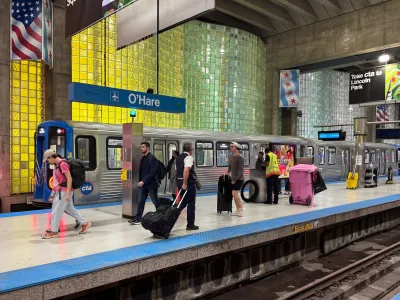
After revising its counting methodology, the Chicago Transit Authority announced that its updated ridership totals for 2025 are roughly 19 million rides higher than previously estimated, reports Ellen Steinke in Streetsblog Chicago.
The revised methodology also reveals bigger differences in which buses get the most use: "Buses in many South and West Side neighborhoods appear significantly busier than previous public data indicated."
According to Steinke, "The changes stem largely from two things: new fareboxes and a new counting methodology using automatic passenger counters, or APCs. These infrared sensors and cameras mounted near bus doors count riders boarding and exiting vehicles regardless of whether they pay a fare and help paint a more accurate picture of ridership." Older counting methods that relied on farebox data and manual video review often undercounted usage, the agency said.
The revised data indicate that "the routes serving some of Chicago’s most transit-dependent communities may also have been among the system’s most undercounted," which could have major implications for how the agency evaluates ridership and user needs. They also show that "underpaid" rides — "trips where riders either paid reduced fares, insufficient fares, or no fares at all" — made up 20% of bus rides and around 5% of rail rides.
Read the full story: CTA revises ridership upward by 19 million trips after methodology update
Chicago Transit Agencies on Brink of Major Crisis
Without additional funding, regional transit agencies will be forced to cut services by 40 percent.
Chicago Transit Increasing Rail Service to Pre-Pandemic Levels
The Chicago Transit Authority is close to returning both rail and bus service to pre-pandemic schedules, with some adjustments for new travel demand.
Chicago Transit Ridership Continues to Grow
The city’s three regional agencies are seeing ridership reaching 64 percent of 2019 levels.

Planetizen Federal Action Tracker
A weekly monitor of how Trump’s orders and actions are impacting planners and planning in America.

Washington state to charge fee to drivers with fuel-efficient cars
Revenue from the fee will go towards supporting the state’s highways.

Illinois considers spending $1 billion in taxpayer money on data center
A quantum computing campus and data center are currently under construction in Chicago.

People Mover delayed again, LAX and contractor trade barbs
The automated train was last slated to open in January 2027.

Trump to blast ‘hydrocarbon highway’ through ‘world’s longest art gallery’
Environmental and historic preservation groups are suing to stop the project.

25 states cast bids to be the home of U.S. Space Academy
The academy will train scientists, officers and astronauts for the U.S. Space Force.

FREE Course: Walkable City 1: Why Walkability?
After describing his path towards focusing on walkability as the essence of good planning, Jeff Speck marches through his five principal reasons for making more walkable places.
Reinventing Malls: Planning Alchemy—Turning Gray Fields Into Gold
The course focuses on the opportunities and imperatives that shape reinvention of mall sites.

City of Charlotte
City of Rosemead
Rutgers University, Edward J. Bloustein School of Planning and Public Policy
University of Michigan School for Environment and Sustainability (SEAS)
Hunter College, City University of New York (CUNY)
The Architects Foundation
University District Partnership