As the Louisiana Legislature advances election maps that would pull apart New Orleans' minority-majority district, leaders urge action.


‘Recognize the danger’: New Orleans leaders urge activism with redistricting writing on the wall
A day before state lawmakers were expected to advance congressional maps to curb or outright eliminate Louisiana’s Black representation in Congress, a panel of city leaders called on a standing-room-only crowd to rally behind Democratic candidates and officials rather than give up hope.
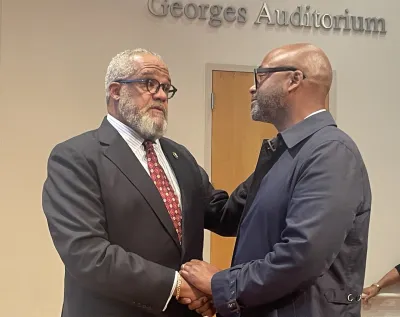
More than 300 people filled the Georges Auditorium at Dillard University for a town hall Monday night hosted by U.S. Rep. Troy Carter, D-New Orleans, whose future in Congress is in jeopardy as the Louisiana Legislature advances election maps that would pull apart his minority-majority district.
His potential fate, and the recent U.S. Supreme Court decision to diminish Black voters’ ability to fight election discrimination, drove the panel discussion at the historically Black college campus. It featured Mayor Helena Moreno, Councilman at-large JP Morrell and District Attorney Jason Williams, all Democrats who find themselves at odds with Republican Gov. Jeff Landry over measures he backs that target elected officials in the city.
“We must recognize the danger in front of us and unite like never before,” Carter told the capacity crowd estimated to exceed 300 people.
“If your vote were not important, they wouldn’t be trying to turn the clock back to try and lessen the voices of minorities,” Carter added.
Voting districts favoring minorities in southern states have been in the crosshairs since the Supreme Court’s April 29 ruling in Louisiana v. Callais, which imploded Section 2 of the landmark Voting Rights Act of 1965. A group of white voters, led by Phillip “Bert” Callais of Brusly, successfully challenged a 2024 version of the state’s congressional map that added a second majority-Black district to the state’s six U.S. House seats. In his majority opinion, Justice Samuel Alito declared the map an unconstitutional racial gerrymander.
Proposals to erase one or both of Louisiana’s majority-Black districts were expected to advance Tuesday from a state Senate committee. One scenario could place Carter in the same districts as the state’s other Black member of Congress, U.S. Rep. Cleo Fields, D-Baton Rouge.
To allow for new districts to be drawn, Landry paused the May 16 party primary elections for the state’s U.S. House seats, even with more than 42,000 absentee ballots already received.
Carter told the audience the long-term fix for the damage he sees from the Callais ruling is for Congress to approve a “bulletproof” federal law that would withstand challenges before the far-right Supreme Court. Specifically, he noted the John Lewis Voting Rights Act, named after the late Civil Rights era icon and congressman from Georgia.
The measure would restore the anti-discrimination standards that justices struck down in the Louisiana case, and it would also require pre-clearance of election law changes from the federal government for states with a history of restrictions against minority voters. The original Voting Rights Act put these reviews in place, but a Supreme Court 2013 ruling in an Alabama redistricting case declared the requirement “outdated.”
U.S. House Democrats advanced the original John Lewis Voting Rights Act in 2021, but it faltered in the Senate. Efforts to revive the measure also failed in 2022 and last year, and Carter told the crowd putting Democrats back in control of Congress would assure the act’s passage.
The overriding message from Carter and other panelists was equal parts dire warning and a call to action.
Morrell explained how the Callais decision’s trickle-down impact on state-level elections could tip the scales of power further against New Orleans. He used the example of the state Public Service Commission, which has one Black representative among its five members. Commissioner Davante Lewis’ district includes parts of the Crescent City.
If those boundaries were to be revised without discrimination guardrails, New Orleans could be pit against the rest of the state on utility regulation matters, Morrell said. The City Council currently has regulatory power over its power provider, Entergy, but Morrell noted there is a proposal in Baton Rouge to pull utility oversight from the city and give that power to the business-friendlier Public Service Commission.
Morrell also lamented the outsized influence Republicans have gained over Louisiana politics — holding all statewide elected seats and super majorities in state legislature — despite Democrats holding an advantage in registered voters in the state. As of May 1, there were 1.07 million Democrats registered to vote in Louisiana compared with 1.05 million Republicans.
“It is beyond my understanding how we as a party let it get to this point …” Morrell said. “We now have to fight from behind.”
This story was originally published by the Louisiana Illuminator, part of States Newsroom, a nonprofit news network, under a creative commons license. The headline was chosen by Planetizen staff.
FULL STORY: ‘Recognize the danger’: New Orleans leaders urge activism with redistricting writing on the wall


Planetizen Federal Action Tracker
A weekly monitor of how Trump’s orders and actions are impacting planners and planning in America.

The state-sanctioned urbicide of Austin
People don’t kill cities. Freeways do.

US to reduce Colorado River water deliveries to Mexico
A new Colorado Treaty amendment reduces Mexico’s Colorado River water allocation by 250,000 acre feet.

Colorado’s Largest Data Center Could Rise Next to Homes — Without a Public Hearing
The proposed campus would consume 11 times the power of Denver International Airport; as it has across the country, opposition mounts.

5 New England states march closer to 800 megawatt wind energy project
Securing federal approval for the project may be complicated under the Trump administration, which has historically been hostile towards domestic wind power.

Baltimore to break ground on $50 million Transit Priority Project
The project will bring faster bus trips, safer streets and better bike connections to Baltimore.

FREE Course: Walkable City 1: Why Walkability?
After describing his path towards focusing on walkability as the essence of good planning, Jeff Speck marches through his five principal reasons for making more walkable places.
Reinventing Malls: Planning Alchemy—Turning Gray Fields Into Gold
The course focuses on the opportunities and imperatives that shape reinvention of mall sites.

Eagle County Government
Harvard University Graduate School of Design
Nashville Planning Department
The Architects Foundation
University of Cincinnati Online
The Pocatello Development Authority
The Urban Renewal Agency of the City of Pocatello
Journal of the American Planning Association