Austin's school district has reported over a dozen incidents when Waymo robotaxis don't follow state law when approaching school buses.



The Austin Independent School District in Texas worked with Waymo for months on training its robotaxis to safely and legally stop for school buses — to little effect, according to an article by Aarian Marshall in Wired.
"An official with the Austin Independent School District (AISD) alleged that the vehicles had, in at least 19 instances, “illegally and dangerously” passed the district’s school buses while their red lights were flashing and their stop arms were extended rather than coming to complete stops, as the law requires." The National Highway Traffic Safety Administration ordered a federal recall in December related to the incidents, but the district continued to report incidents into the following months.
"Self-driving software has long struggled with recognizing flashing emergency lights and road safety devices with long, thin arms, including gates and stop-arms, says Missy Cummings, who researches autonomous vehicles at George Mason University and served as a safety adviser to the NHTSA during the Biden administration."
Read the full story: A School District Tried to Help Train Waymos to Stop for School Buses. It Didn’t Work

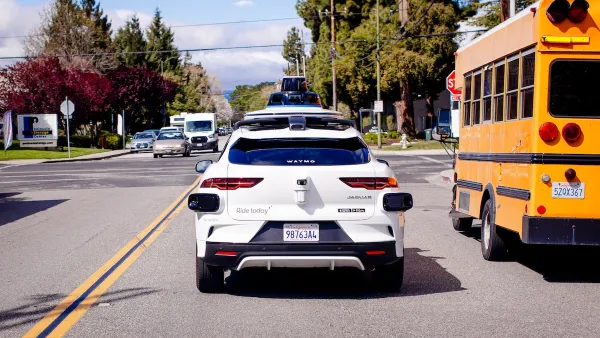
Waymo Robotaxis Under Investigation for Dangerous Driving Near School Buses
This isn’t the first federal investigation for the Alphabet-owned company, which was forced to issue two recalls earlier this year due to safety concerns over the cars’ “unexpected behavior.”

Feds say robotaxis interfering with first responders is a 'functional insufficiency,' demand solutions by August
The NHTSA issued a letter to autonomous carmakers, noting that 'Every second matters when law enforcement officers, firefighters, or paramedics are answering a call.'

Waymo's troubles with emergency vehicles are getting worse
In one case, first responders waited 53 minutes to reach a Waymo support representative during an emergency.

Planetizen Federal Action Tracker
A weekly monitor of how Trump’s orders and actions are impacting planners and planning in America.

California plans to bury El Niño’s downpour
If the state plays its cards right, it may be able to store a billion acre-feet of El Niño’s water in aquifers.

Chicago breaks ground on $3 billion megadevelopment
The new neighborhood, titled Foundry Park, will one day host 3,700 residences.

California High-Speed Rail Authority CEO resigns after $600,000 scandal
Under Ian Choudri, the authority used taxpayer dollars to fund first class flights and trips to nightclubs.

Want to study the Missouri River? Soon, you may need unanimous approval from 10 states
Legislation would require 10 governors’ permission to study or build projects moving water outside the basin.

Desperate measures: Advocates weigh draining Lake Powell to fill Colorado River
Draining the reservoir could reduce evaporation losses by a couple hundred thousand acre-feet.

FREE Course: Walkable City 1: Why Walkability?
After describing his path towards focusing on walkability as the essence of good planning, Jeff Speck marches through his five principal reasons for making more walkable places.
Reinventing Malls: Planning Alchemy—Turning Gray Fields Into Gold
The course focuses on the opportunities and imperatives that shape reinvention of mall sites.

City of Rosemead
Rutgers University, Edward J. Bloustein School of Planning and Public Policy
One Hundred Miles
Hunter College, City University of New York (CUNY)
The Architects Foundation
University of Cincinnati Online
City of Cambridge
Montrose County
The Pocatello Development Authority