A new policy that requires buildings with four or more units to bury their electrical lines is making housing development more costly and causing months-long delays.


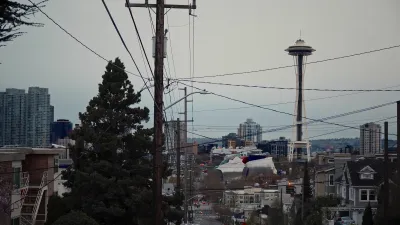
Seattle wants developers to build more housing, and has changed its zoning regulations to make that easier.
But builders are running up against another obstacle, explains Greg Kim in The Seattle Times: a February 2025 policy from Seattle City Light required housing with four or more units to connect to the electrical grid underground. “Some builders are in an uproar, saying the process of burying wires can involve uncertain permitting timelines with multiple city departments, requiring months to years of design and engineering, and is preventing some housing from ever being built.”
Seattle City Light says the rule was prompted by broader policy changes, and that “its poles can’t physically support the added electrical load, so lines must go underground.” With new city and state laws requiring electric heat pumps and EV charging capacity in new housing, the utility says that new multifamily projects require much more power, thicker wiring, and larger transformers than single-family homes. This all adds significant weight to power poles.
It’s unclear how much impact the undergrounding requirements are making, but Kim notes that “Seattle issued permits for 9% fewer town home and row house units in 2025 than the year before, dropping from 634 to 579, despite more lots being made available for fourplexes and sixplexes to comply with the state’s middle-housing rules.”
FULL STORY: Seattle’s climate and housing efforts bottlenecked by … power poles?

Seattle upzoning proposal seeks to boost density, support eco-friendly building materials
A city committee advanced the plan to target areas already open to multifamily development for additional density and encourage passive house and mass timber construction.
Planning Trends for 2026: States and Cities Take Initiative, Passenger Rail Gains Steam, and the Costs of AI Revealed
With federal funding for everything from transportation projects to housing assistance under threat, city and state governments are poised to take a stronger role in building strong, resilient local economies and public services.
US May Have 100 Times More Blackouts by 2030
Rising demand driven by AI data centers and uncertain energy sources could lead to a surge in power outages by the end of the decade.

Planetizen Federal Action Tracker
A weekly monitor of how Trump’s orders and actions are impacting planners and planning in America.

The state-sanctioned urbicide of Austin
People don’t kill cities. Freeways do.

US to reduce Colorado River water deliveries to Mexico
A new Colorado Treaty amendment reduces Mexico’s Colorado River water allocation by 250,000 acre feet.

5 New England states march closer to 800 megawatt wind energy project
Securing federal approval for the project may be complicated under the Trump administration, which has historically been hostile towards domestic wind power.

Baltimore to break ground on $50 million Transit Priority Project
The project will bring faster bus trips, safer streets and better bike connections to Baltimore.

Airbnb launches $250 million 'last-dollar financing' housing accelerator, makes first investment in Austin
The company will put $6.4 million towards affordable housing development in Texas’ capital.

FREE Course: Walkable City 1: Why Walkability?
After describing his path towards focusing on walkability as the essence of good planning, Jeff Speck marches through his five principal reasons for making more walkable places.
Reinventing Malls: Planning Alchemy—Turning Gray Fields Into Gold
The course focuses on the opportunities and imperatives that shape reinvention of mall sites.

Eagle County Government
Harvard University Graduate School of Design
Nashville Planning Department
The Architects Foundation
University of Cincinnati Online
The Pocatello Development Authority
The Urban Renewal Agency of the City of Pocatello
Journal of the American Planning Association